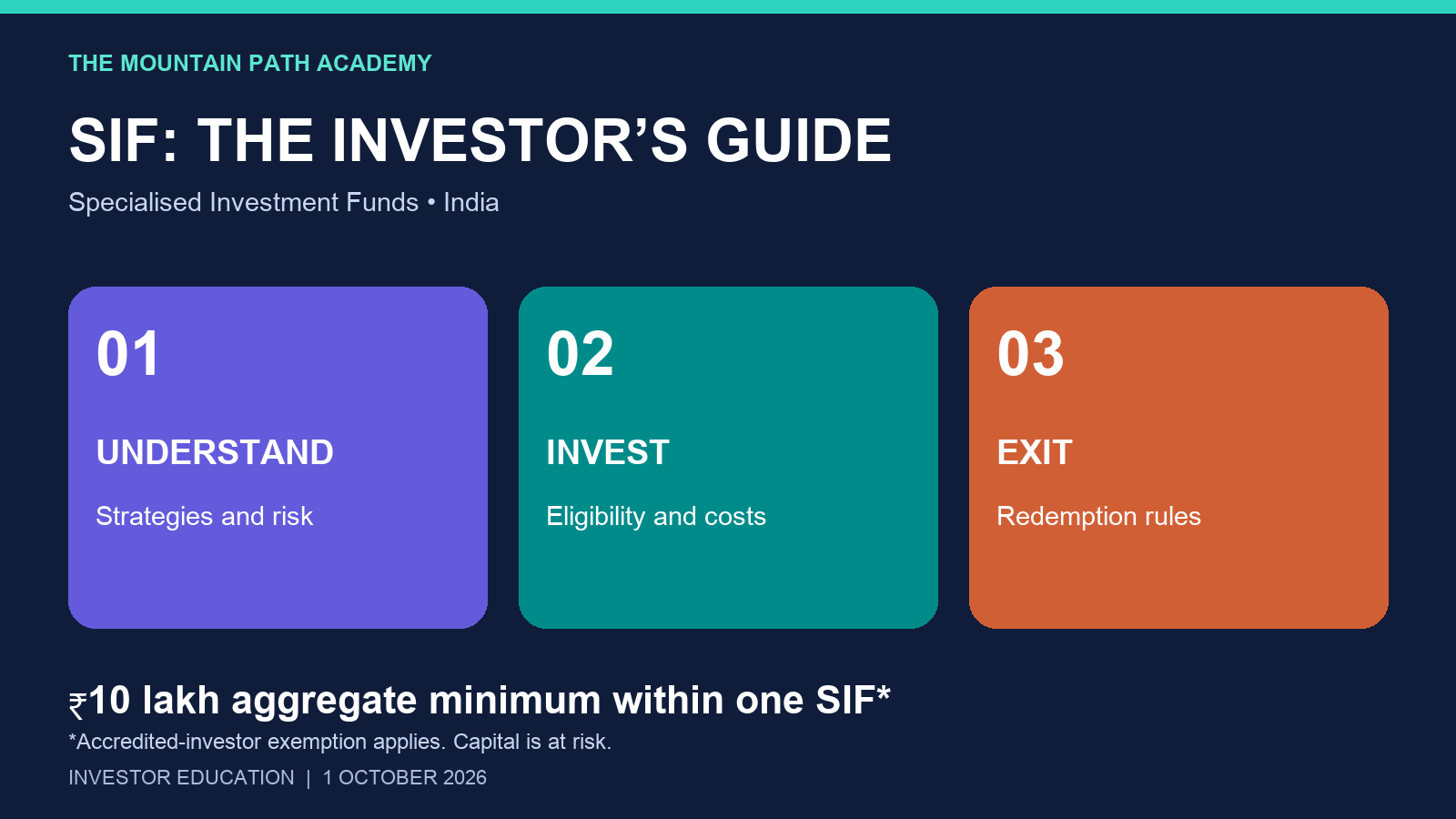
More investment flexibility brings more decisions to understand. Before committing ₹10 lakh to a Specialised Investment Fund, ask three questions: What can the manager do? How can I lose money? When can I withdraw?
This guide brings those questions together—with examples you can follow without a finance textbook.
What is a SIF?
A Specialised Investment Fund (SIF) is a pooled investment product within India’s mutual fund framework. It offers advanced strategies, including limited unhedged short exposure through derivatives, and bridges the flexibility gap between regular mutual funds and Portfolio Management Services (PMS).
You own units in a common portfolio. You do not receive an individually managed PMS account. SIFs are intended for informed investors who can understand complex strategies and tolerate losses. Source: SEBI investor FAQs, September 2026.
A useful starting point: assess a SIF by the job it would perform in your portfolio. A sophisticated name is no substitute for a clear investment purpose.
Who can invest—and how much?
Depending on the investment strategy’s documents, eligible applicants can include resident individuals, HUFs, companies, partnerships, LLPs, eligible trusts and institutions, and NRIs/OCIs subject to applicable restrictions. Some documents also permit minors through guardians. Eligibility must be checked in the specific offer document; overseas residence can introduce additional restrictions. PAN, KYC and supporting authorisations are required as applicable. Example eligibility provisions: investment strategy document hosted by AMFI, pages 59–61.
The ₹10 lakh rule
- The minimum aggregate investment is ₹10 lakh across strategies offered by the same SIF, assessed at PAN level.
- Regular mutual fund holdings do not count, even with the same AMC.
- Separate SIFs cannot be combined to satisfy one threshold.
- Accredited investors are exempt from this minimum. Being wealthy alone does not establish accredited status—you need a valid accreditation certificate (see definition below).
- Joint holdings use the first holder’s PAN for this assessment.
- SIPs, STPs and SWPs may be available, subject to strategy terms and threshold compliance. Source: SEBI investor FAQs.
Definition: who is an accredited investor?
| Investor type | Eligibility (any one route) |
|---|---|
| Individuals, HUFs, family trusts, sole proprietorships | Annual income ≥ ₹2 crore; or Net worth ≥ ₹7.5 crore, of which at least ₹3.75 crore is in financial assets; or Annual income ≥ ₹1 crore and net worth ≥ ₹5 crore, of which at least ₹2.5 crore is in financial assets |
| Partnership firms | Each partner must independently meet the individual criteria |
| Trusts (other than family trusts) | Net worth ≥ ₹50 crore |
| Body corporates | Net worth ≥ ₹50 crore |
Deemed accredited—no certificate needed: the Central and State Governments, developmental agencies and funds set up by them, qualified institutional buyers, Category I foreign portfolio investors, sovereign wealth funds and multilateral agencies.
How accreditation works
- Who certifies: accreditation agencies notified by SEBI—subsidiaries of depositories and stock exchanges, such as CDSL Ventures Ltd and BSE Administration & Supervision Ltd. The AMC does not decide this itself.
- Validity: generally one year if you meet the criteria for the preceding year, or two years if you have met them consistently for the preceding three years. Renew it to keep the status.
- Trade-off: accreditation unlocks lower minimums and lighter product rules. In exchange, you accept that some regulatory protections designed for retail investors may apply less, so it is a choice, not a badge.
Illustration: Rohan earns ₹1.2 crore a year and has a net worth of ₹6 crore, including ₹3 crore in shares, bonds and fund units. He meets the third route (income ≥ ₹1 crore, net worth ≥ ₹5 crore, financial assets ≥ ₹2.5 crore). Once certified, he could invest below ₹10 lakh in a SIF. Without the certificate, the ₹10 lakh minimum applies to him like anyone else.
Source: SEBI (Alternative Investment Funds) Regulations, 2012, Regulation 2(1)(ab), and SEBI’s 2021 framework for accredited investors; see a plain-language summary of the criteria. Thresholds and procedures can be revised; confirm with an accreditation agency.
Illustration: one SIF, two strategies
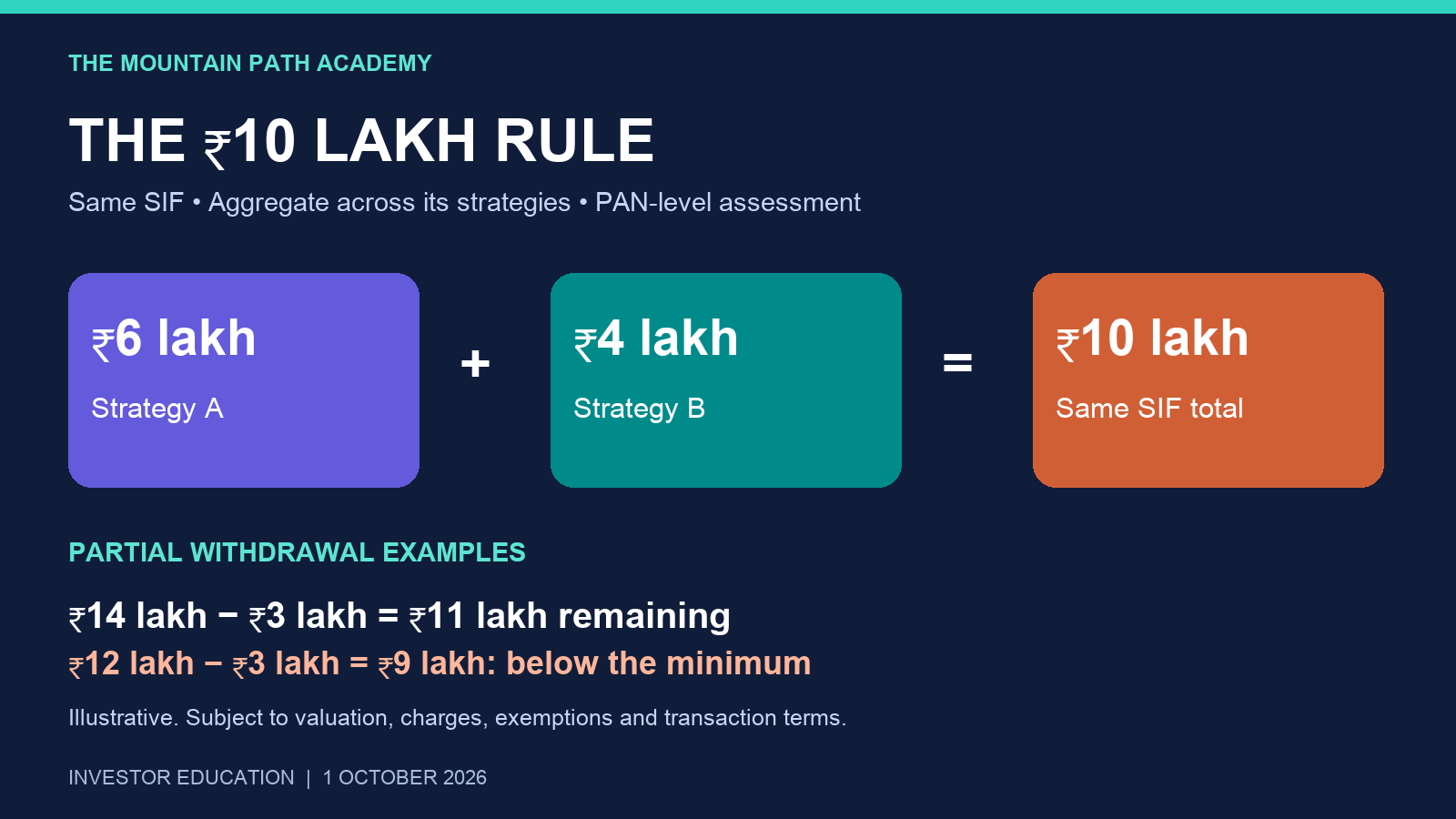
₹6 lakh in Strategy A + ₹4 lakh in Strategy B = ₹10 lakh within the same SIF, assuming the transactions satisfy its processing requirements.
By contrast, ₹6 lakh in SIF X and ₹4 lakh in SIF Y would leave each below its own threshold. Similarly, ₹8 lakh in ordinary mutual funds plus ₹2 lakh in a SIF does not meet the SIF requirement.
The minimum is an entry condition—not a recommended allocation. If ₹10 lakh represents most of your investible savings, assess the concentration and liquidity consequences before proceeding.
Mutual funds, SIFs, PMS and AIFs
Most SIF investors are really choosing among four routes. The ₹10 lakh entry point places SIFs well below PMS (₹50 lakh) and AIFs (₹1 crore), while keeping the pooled mutual fund structure.
| Feature | Mutual fund | SIF | PMS | AIF (Category III) |
|---|---|---|---|---|
| Minimum investment | Scheme-specific; often small amounts | ₹10 lakh per SIF (PAN level) | ₹50 lakh | ₹1 crore (lower for the manager’s employees/directors) |
| What you own | Units of a pooled scheme | Units of a pooled strategy | Securities held directly in your own account | Units of a pooled fund |
| Short exposure / leverage | Limited; derivatives within scheme rules | Unhedged short via derivatives up to 25% of net assets | No leverage; derivatives within regulatory limits | Can use leverage and complex trading within SEBI limits |
| Liquidity | Daily for most open-ended schemes | Strategy-specific frequency; notice up to 15 working days | Withdrawal generally possible; exit charges may apply | Often limited; open- or close-ended by scheme |
| Taxation | Taxed on redemption by fund classification | Same mutual fund rules, by strategy classification | Each underlying trade taxed in your hands | Income generally taxed at fund level (no pass-through) |
| Best suited to | Most investors | Informed investors wanting long–short exposure at a lower entry point | Investors wanting a customised, directly held portfolio | Large, sophisticated investors |
Indicative summary for comparison. PMS and AIF minimums follow the SEBI (Portfolio Managers) Regulations, 2020 and SEBI (Alternative Investment Funds) Regulations, 2012; accredited-investor relaxations and product-specific terms can differ. Check current regulations and offer documents.
SIFs operate under regulatory safeguards, but regulation does not guarantee performance or protect the invested capital. Sources: SEBI’s SIF framework and SEBI investor FAQs.
The seven strategy categories
SEBI’s March 2026 Master Circular sets out these categories:
- Equity Long-Short: at least 80% in equity and equity-related instruments.
- Equity Ex-Top 100 Long-Short: at least 65% in equity and related instruments outside the largest 100 stocks.
- Sector Rotation Long-Short: at least 80% in equity and related instruments across no more than four sectors.
- Debt Long-Short: debt instruments with permitted short exposure.
- Sectoral Debt Long-Short: at least two sectors; maximum 75% in one sector.
- Active Asset Allocator Long-Short: dynamic allocation across permitted asset classes.
- Hybrid Long-Short: at least 25% each in equity/equity-related instruments and debt.
Unhedged short exposure through permitted derivatives is capped at 25% of net assets. This is an exposure limit, not a maximum-loss guarantee. Cumulative gross exposure is subject to the 100% limit and prescribed calculation/offsetting rules. Source: SEBI Master Circular, Chapter 21.
Strategy net assets: ₹100 crore → maximum unhedged short exposure: ₹25 crore
Your share on a ₹10 lakh holding: up to about ₹2.5 lakh of exposure may be unhedged short
The cap limits the size of the position, not the loss. If a shorted stock rises sharply, the loss on that position can exceed the value of the exposure when it was opened.
Derivatives limits at a glance
| Limit | Rule | SEBI framework § |
|---|---|---|
| Unhedged derivatives exposure | Up to 25% of net assets, only in permissible exchange-traded derivatives, for purposes other than hedging and portfolio rebalancing | 6.1.1 |
| Hedging and rebalancing | Permitted in addition to the 25% limit | 6.1.1 (explanation) |
| How exposure is measured | Futures (long or short): futures price × lot size × contracts Options bought: premium paid × lot size × contracts Options sold: underlying market price × lot size × contracts | 6.1.2 |
| Offsetting allowed | Cash and derivative positions on the same underlying; derivative positions on the same underlying | 6.1.4 |
| Overall gross exposure | Equity, debt, derivatives (incl. commodity and fixed-income derivatives), repo and credit default swaps together: not more than 100% of net assets | 6.1.5 |
| Debt concentration | Single issuer: 20% of NAV (AAA), 16% (AA), 12% (A and below); single sector: 25% of NAV | 5.1 |
What this means in practice:
- No leverage: with total exposure capped at 100% of net assets, a SIF cannot gear up the way a Category III AIF can.
- Options written use the cap fastest: a sold option counts at the full value of the underlying, not the premium received.
- Hedges are not “free” forever: only positions on the same underlying can be offset. Shorting an index future against a basket of individual stocks still consumes exposure.
- Market-neutral, not geared: the framework allows a modest net short or neutral book, within the strategy’s category mandate (for example, at least 80% in equity and related instruments for Equity Long-Short).
Source: SEBI SIF framework (February 2025), sections 5.1 and 6.1. Strategy documents may set tighter limits; check the ISID.
Illustration: how a short position works
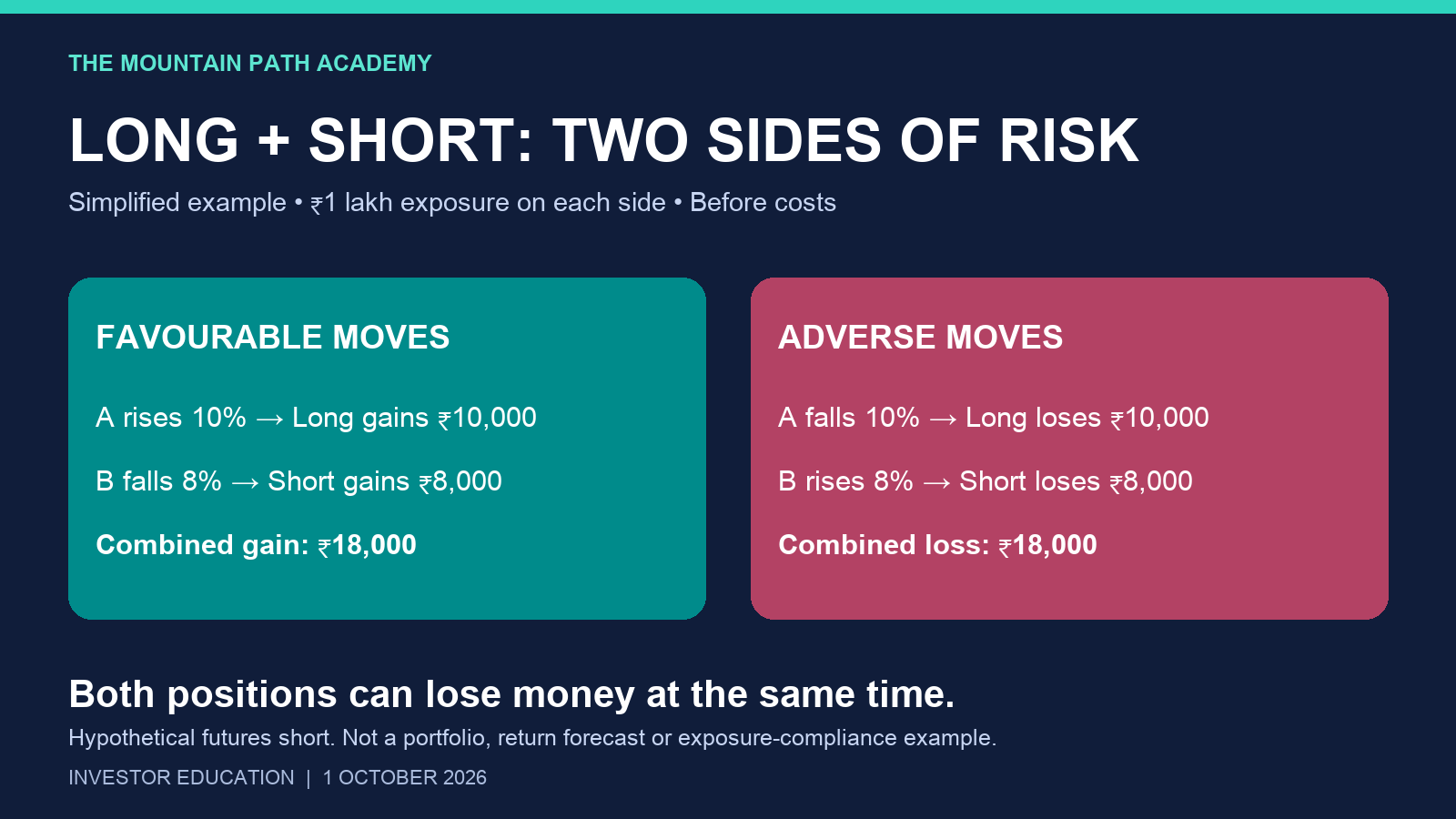
Imagine a manager has a ₹1 lakh long position in A and ₹1 lakh notional short exposure to B through futures.
- A rises 10%: the long position gains approximately ₹10,000.
- B falls 8%: the short position gains approximately ₹8,000.
- Combined illustrative gain: ₹18,000 before costs.
Now reverse the outcome: A falls 10% and B rises 8%. The combined loss is approximately ₹18,000 before costs.
These are simplified position-level examples, not a complete SIF portfolio, return forecast or illustration of regulatory exposure compliance. Actual results depend on instruments, margins, pricing and costs.
Long–short investing can lose money on both sides.
Reading the SIF risk band
Each strategy discloses a risk band on a five-level scale, from Level 1 (lowest) to Level 5 (highest). It summarises portfolio risk, including derivatives positions, and is reviewed as the portfolio changes.
- Use it to compare strategies within the same category.
- A lower level does not mean protection from loss.
- Check whether the level has changed since you invested.
Read the band together with the strategy’s actual long and short exposures, liquidity terms and manager track record.
Redemptions: understand the exit before entering
Check three separate clocks
Dealing window → notice period, if any → payment processing.
Subscription and redemption frequencies can differ. A strategy accepting daily investments need not offer daily withdrawals. Where a redemption notice applies, it may be up to 15 working days, with the relevant NAV determined at the end of that notice. Interval and close-ended strategies must be listed; listing does not assure a willing buyer at your preferred price. Source: SEBI SIF framework, sections 7–8.
Check the current ISID for payment timing, cut-offs, exit loads and exceptional circumstances. For example, the cited equity strategy document specifies normal redemption payments within three working days. That should not be treated as a universal promise that every SIF pays three days after your initial instruction. Example: redemption provisions.
Partial withdrawal examples
Case A: ₹14 lakh balance → withdraw ₹3 lakh → ₹11 lakh remains.
The remaining amount clears the threshold, subject to valuation, charges and the strategy’s transaction terms.
Case B: ₹12 lakh balance → request ₹3 lakh → ₹9 lakh would remain.
This would breach the minimum. Do not assume the partial withdrawal will be accepted; discuss a compliant amount or full exit with the AMC.
Case C: ₹10 lakh falls to ₹9 lakh because markets decline.
This passive breach does not force redemption. You may keep holding. While below the threshold, a redemption must cover the entire remaining investment in that SIF. Source: SEBI framework, section 4.1.4.
What if an investor’s transaction causes a breach?
The monitoring framework provides for a debit freeze across the investor’s units in the concerned SIF and a 30-calendar-day notice to restore compliance. If corrected, the freeze is lifted. Otherwise, automatic redemption applies at the NAV of the next business day after the 30th calendar day. This is a breach-remediation process, not a facility for investing below the minimum. Source: SEBI threshold-monitoring circular.
Costs, tax and the return you actually keep
Costs to examine
Compare the disclosed total expense ratio, direct versus regular plan costs, transaction costs and any exit load. Fund expenses reduce NAV; brokerage and derivative trading costs can also affect the outcome. Avoid comparing only the headline management charge. Example fee disclosures: investment strategy document, pages 25–27.
Tax snapshot: resident individuals
The SIF label alone does not determine taxation. Confirm the strategy’s tax classification.
- Equity-oriented: gains on units held up to 12 months generally attract 20%; longer holdings attract 12.5% on aggregate qualifying long-term gains exceeding ₹1.25 lakh in the tax year, subject to STT conditions.
- Specified mutual funds: qualifying units acquired on or after 1 April 2023 generally have gains treated as short term at applicable rates regardless of holding period. The definition includes funds with more than 65% in debt/money-market instruments and specified funds investing in them.
- Other non-equity funds: long-term treatment generally begins after 12 months for listed units or 24 months for unlisted units; the long-term rate is 12.5% without indexation. Short-term gains generally attract applicable slab rates.
Likely tax treatment by strategy (indicative)
| Strategy | Mandate | Likely classification |
|---|---|---|
| Equity Long-Short | ≥80% equity and related | Usually equity-oriented |
| Equity Ex-Top 100 Long-Short | ≥65% equity outside top 100 | Often equity-oriented; check the listed domestic equity share |
| Sector Rotation Long-Short | ≥80% equity, ≤4 sectors | Usually equity-oriented |
| Debt Long-Short | Debt instruments | Likely specified mutual fund: slab rate |
| Sectoral Debt Long-Short | Debt across ≥2 sectors | Likely specified mutual fund: slab rate |
| Active Asset Allocator Long-Short | Dynamic across asset classes | Depends on the actual allocation |
| Hybrid Long-Short | ≥25% each in equity and debt | Depends on the mix; often “other non-equity” |
Classification follows the strategy’s actual portfolio, not its name, and can change. Confirm with the AMC’s disclosure for the relevant tax year.
Applicable surcharge and cess are additional. Distributions, NRI withholding and individual circumstances need separate assessment. The ₹1.25 lakh equity exemption is not available afresh for each fund. Source: HDFC Mutual Fund’s Tax Year 2026–27 reckoner.
Your investment checklist
Before applying, work through these questions:
- Purpose: What gap would this strategy fill in my existing portfolio?
- Loss capacity: What would I do if ₹10 lakh became ₹8 lakh? This is a hypothetical stress test, not a worst-case limit.
- Liquidity: Could I meet an unexpected expense while waiting for the next permitted exit?
- Manager: Is there evidence of experience with this specific strategy?
- Performance: Am I comparing returns after expenses, against a relevant benchmark, over a meaningful period?
- Portfolio: Do I understand the largest positions and the long and short exposures?
- Documents: Have I read the ISID, KIM, SAI and current addenda?
- Costs and tax: What would I retain after expenses, exit charges and tax?
Complete the AMC’s onboarding requirements, select the strategy and plan, confirm threshold compliance, and check the allotment statement. Thereafter, review disclosures and whether the investment still fits your goal. Read the five-level SIF risk band alongside the underlying risks. Source: SEBI Master Circular, Chapter 21.
Explore SIFs with Value Research
For a practical research starting point, visit the Value Research SIF Screener.
As you research funds, build a shortlist around these questions:
- Comparable strategy: Are the funds pursuing similar objectives?
- Comparable returns: Are you comparing the same period, plan and option?
- Track record: How much actual operating history supports the performance numbers?
- Costs and liquidity: What do the latest AMC disclosures say about expenses, exit loads and redemption windows?
- Portfolio fit: What would this fund add to the investments you already own?
Use the screener alongside each fund’s current documents. A return ranking alone does not establish suitability, and a short performance history cannot demonstrate resilience across a full market cycle.
Research sequence: explore the screener → read the shortlisted strategies’ documents → compare risks and exit terms → assess suitability.
Three worked cases: entry, portfolio mix and exit
Assumptions for all three cases: fictional investors, non-accredited status, completed onboarding, and strategies available within the named fictional SIF. Allocations are amounts invested in strategy units—not the underlying fund’s asset allocation. Entry values are assumed to be successfully allotted and compliant after applicable charges. Later values are hypothetical, not forecasts. Redemption figures are gross, before exit loads and taxes; market movements can change the permitted amount and final proceeds.
Case 1 — Equity-focused investor: taking out part of a gain
Entry: Meera allocates ₹12 lakh to two strategies in fictional SIF Alpha. She keeps her emergency savings separately.
| Strategy | Entry amount | Illustrative value before withdrawal | Gross redemption | Remaining value |
|---|---|---|---|---|
| Equity Long-Short | ₹8 lakh | ₹9 lakh | ₹2 lakh | ₹7 lakh |
| Equity Ex-Top 100 Long-Short | ₹4 lakh | ₹4.5 lakh | Nil | ₹4.5 lakh |
| Total in SIF Alpha | ₹12 lakh | ₹13.5 lakh | ₹2 lakh | ₹11.5 lakh |
Entry check: ₹8 lakh + ₹4 lakh = ₹12 lakh within one SIF. Neither individual strategy needs to hold ₹10 lakh under the aggregate threshold rule; strategy-specific application minimums still apply.
Exit decision: Meera requests ₹2 lakh from the Equity Long-Short strategy. The illustration leaves ₹11.5 lakh across Alpha, so it clears the aggregate threshold. If she instead requested ₹4 lakh, only ₹9.5 lakh would remain and that partial withdrawal would not comply.
Timing: assume the chosen equity strategy offers daily redemptions without a notice period. Meera still follows its cut-off and settlement terms. Daily dealing is an assumption for this case, not a promise for all equity SIF strategies.
Portfolio lesson: both strategies have equity exposure. Owning two strategies does not necessarily provide diversification across asset classes.
Case 2 — Equity plus hybrid: a market fall changes the exit options
Entry: Arjun invests ₹10 lakh in fictional SIF Beta, combining an equity strategy with a hybrid strategy.
| Strategy | Entry amount | Illustrative value after market losses |
|---|---|---|
| Equity Long-Short | ₹6 lakh | ₹5.1 lakh |
| Hybrid Long-Short | ₹4 lakh | ₹3.9 lakh |
| Total in SIF Beta | ₹10 lakh | ₹9 lakh |
Entry check: the two subscriptions total ₹10 lakh. Arjun arranges them within the applicable processing requirements; he should not assume that a failed second subscription leaves the first valid below the threshold.
Exit decision: Arjun now needs ₹2 lakh. The ₹9 lakh balance results solely from market losses, so he can continue holding without a compulsory exit. However, while the total remains below ₹10 lakh, he cannot redeem only ₹2 lakh. An exit must cover his entire remaining holding across Beta, subject to its redemption arrangements.
Alternative: a ₹3 lakh top-up would lift the assumed balance to ₹12 lakh, so a ₹2 lakh withdrawal would leave ₹10 lakh—subject to fresh valuation and dealing dates. Adding money only to withdraw it is not a recommendation.
Timing: assume the equity strategy deals daily and the hybrid strategy permits withdrawals on two specified days each week. For a complete exit, Arjun coordinates the instructions with the AMC; proceeds from the two strategies need not arrive together.
Portfolio lesson: a hybrid allocation does not eliminate losses. Its equity holdings may also overlap with the equity strategy.
Case 3 — Debt plus multi-asset: planning staged withdrawals
Entry: Kavya allocates ₹15 lakh to fictional SIF Gamma. She also owns ₹5 lakh in ordinary mutual funds outside the SIF.
| Holding | Entry amount | Counts towards Gamma’s SIF threshold? |
|---|---|---|
| Debt Long-Short | ₹9 lakh | Yes |
| Active Asset Allocator Long-Short | ₹6 lakh | Yes |
| Ordinary mutual funds | ₹5 lakh | No |
| Total invested / qualifying SIF amount | ₹20 lakh | ₹15 lakh qualifies |
Entry check: Gamma independently satisfies the ₹10 lakh minimum. The ordinary mutual fund balance neither increases that qualifying amount nor supports a later shortfall.
First withdrawal: assume Gamma’s values remain ₹9 lakh and ₹6 lakh. Kavya redeems ₹4 lakh from the Debt Long-Short strategy, leaving ₹5 lakh in debt plus ₹6 lakh in the allocator: ₹11 lakh in Gamma.
Second withdrawal: another ₹2 lakh would leave ₹9 lakh and would not meet the threshold. At unchanged values, ₹1 lakh is the arithmetic maximum partial withdrawal before reaching ₹10 lakh; valuation changes can reduce that amount. A full exit is another option under the applicable terms.
Timing illustration: suppose the debt strategy offers weekly dealing and the allocator offers monthly dealing, with a stated request window and notice period. Kavya must use each strategy’s actual calendar. A full exit from both may involve different NAV dates and payment dates; she should not plan a fixed bill payment around unconfirmed proceeds.
Across-provider variation: if the ₹9 lakh debt allocation were in SIF Gamma and the ₹6 lakh allocator allocation in SIF Delta, neither would meet its own minimum. The combined ₹15 lakh would not solve that. At entry, a two-provider combination would generally need at least ₹10 lakh in each SIF for this non-accredited investor.
Portfolio lesson: debt strategies still face credit, interest-rate and derivatives risks. A multi-asset strategy can overlap with debt holdings and does not guarantee liquidity or capital protection.
What the three cases teach
Check the same-SIF aggregate at entry. Recalculate it before each partial withdrawal. Plan the exit using each strategy’s dealing calendar.
The examples apply the threshold and transaction principles described in SEBI’s investor FAQs, questions A6–A18. All assumed dealing schedules must be replaced with the selected strategy’s current ISID terms before investing.
Frequently asked questions
Quick answers to the questions investors ask most often. Each answer summarises the relevant section of this guide.
Is a SIF the same as a mutual fund?
Not quite. A SIF is offered by a mutual fund house under the mutual fund framework, and you hold units in a pooled portfolio, just as in a mutual fund. But it is a separate product category with a ₹10 lakh minimum and more flexible, long–short mandates than regular mutual fund schemes.
Can I invest less than ₹10 lakh?
Only if you are an accredited investor, who is exempt from the minimum. Otherwise you need at least ₹10 lakh in aggregate within the same SIF. Holdings in ordinary mutual funds, or in a different SIF, do not count towards it.
Who counts as an accredited investor?
An investor certified by a SEBI-recognised accreditation agency. Individuals qualify with annual income of at least ₹2 crore, or net worth of at least ₹7.5 crore (₹3.75 crore in financial assets), or income of ₹1 crore plus net worth of ₹5 crore (₹2.5 crore in financial assets). Body corporates and non-family trusts need net worth of ₹50 crore. The certificate is usually valid for one or two years.
Does the ₹10 lakh have to go into a single strategy?
No. The threshold is assessed at PAN level across all strategies offered by the same SIF, so ₹6 lakh in one strategy and ₹4 lakh in another meets it. Each strategy’s own minimum application amount still applies.
Can I invest through a SIP?
SIPs, STPs and SWPs may be available, depending on the strategy’s terms, provided you meet and maintain the ₹10 lakh threshold. Check the strategy document before setting one up.
What happens if market losses take my investment below ₹10 lakh?
Nothing is forced. A fall caused only by market movement is a passive breach, and you can keep holding. While you are below the threshold, however, any redemption must be for your entire remaining investment in that SIF.
What if my own withdrawal would take me below ₹10 lakh?
A partial withdrawal that leaves less than ₹10 lakh should not be expected to go through. Where an investor’s transaction does cause a breach, SEBI’s monitoring rules provide for a debit freeze and a 30-calendar-day notice to restore compliance; if not corrected, the units are redeemed automatically.
How quickly can I get my money back?
It depends on the strategy. Check three things: how often it accepts redemptions (daily, weekly, monthly or otherwise), any notice period (up to 15 working days), and the payment timeline after the NAV date. Interval and close-ended strategies are listed, but listing does not guarantee a buyer at your price.
How much can a SIF bet against the market?
Unhedged short exposure through exchange-traded derivatives is capped at 25% of net assets. Total gross exposure across equity, debt, derivatives, repo and credit default swaps cannot exceed 100% of net assets, so a SIF cannot use leverage.
Is a SIF safer than a PMS or an AIF?
Not automatically. SIFs operate under SEBI regulation, but regulation does not guarantee returns or protect capital. Risk depends on the strategy, so read its five-level risk band together with its long and short exposures and exit terms.
How are SIF gains taxed?
Like mutual funds, according to how the strategy is classified. Equity-oriented strategies generally attract 20% on gains within 12 months and 12.5% on long-term gains above ₹1.25 lakh a year. Debt-heavy strategies are generally taxed at your slab rate. Surcharge and cess are extra.
Can NRIs invest in a SIF?
Many strategy documents allow NRIs and OCIs, subject to applicable restrictions. Residents of some countries may face additional conditions, so check the specific offer document and the AMC’s onboarding requirements.
Where can I compare SIFs?
The Value Research SIF Screener is a useful starting point for shortlisting. Then read each shortlisted strategy’s ISID, KIM and latest disclosures before deciding.
Sources
- SEBI investor FAQs, September 2026
- Investment strategy document hosted by AMFI, pages 59–61
- SEBI’s SIF framework
- SEBI Master Circular, Chapter 21
- Redemption provisions
- SEBI threshold-monitoring circular
- HDFC Mutual Fund’s Tax Year 2026–27 reckoner
- Value Research SIF Screener
Educational content, not a recommendation to buy a particular investment. SIFs involve market, liquidity and derivatives risks and can lose capital. Examples are hypothetical. Check current offer documents and obtain investment or tax advice suited to your circumstances.
The Mountain Path Academy · https://themountainpathacademy.com