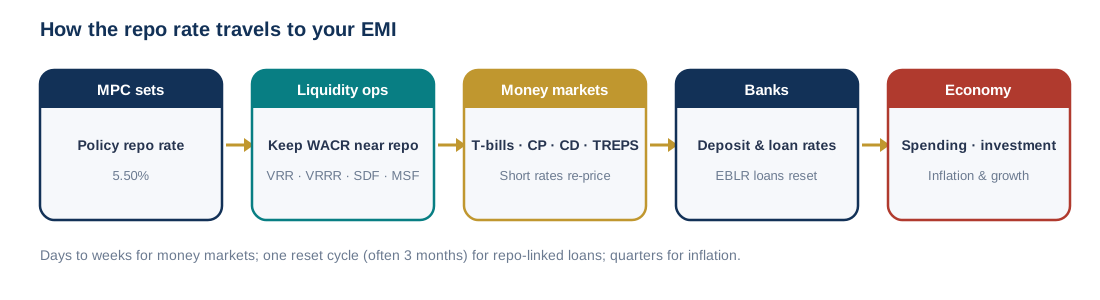
Every headline that says “RBI hikes repo rate” hides a whole machine. The Monetary Policy Committee sets one number. The RBI then uses a set of facilities, auctions and reserve rules to make sure the rates banks actually pay each other overnight stay close to that number — and from there, the change works its way into Treasury bills, deposits, home loans and, eventually, inflation.
This guide takes each tool in turn — repo, reverse repo, SDF, MSF, Bank Rate, CRR, SLR, VRR and VRRR — with a definition, the current rate, a worked example and the reason it exists. It ends with the real 2026 episode in which a ₹10 lakh crore liquidity surplus pushed the RBI into bond sales and a rate hike.
Why does the RBI need a toolkit?
The RBI's monetary policy goal is price stability — CPI inflation of 4% within a band of 2% to 6% — while keeping growth in mind. Its signal is the policy repo rate. Its operating target is the weighted average call rate (WACR): the rate at which banks lend reserves to each other overnight. If the call rate drifts far from the repo rate, the signal is lost; so the RBI needs tools that add money when it is scarce and remove it when it is plentiful.
Rate tools vs reserve tools
Think of the toolkit in two families. Rate tools set the price at which banks can borrow from or lend to the RBI. Reserve and quantity tools change how much money is in the system or how much banks must lock away.
| Tool | Family | What it does | Current setting |
|---|---|---|---|
| Repo rate | Rate | Policy signal; rate for RBI lending to banks against G-secs | 5.50% |
| SDF | Rate | Floor: banks deposit surplus overnight, no collateral | 5.25% |
| MSF | Rate | Ceiling: emergency overnight borrowing | 5.75% |
| Bank Rate | Rate | Reference for penal rates; aligned to MSF | 5.75% |
| Fixed reverse repo | Rate | Old floor; kept for discretionary use | 3.35% |
| VRR / VRRR | Quantity (auction) | Inject / absorb a chosen amount for a chosen tenor | 7-day main operation |
| CRR | Reserve | Cash a bank must keep with the RBI | 3% of NDTL |
| SLR | Reserve | Liquid assets a bank must hold itself | 18% of NDTL |
| OMOs / FX swaps | Quantity (durable) | Buy or sell G-secs / swap dollars to change durable liquidity | ₹1 trn OMO sales, Sep 2026 |
Rates as on 7 October 2026. Source: RBI MPC resolution, 7 Oct 2026; key RBI rates summary (CRR, SLR, fixed reverse repo).
Repo rate — the price of money
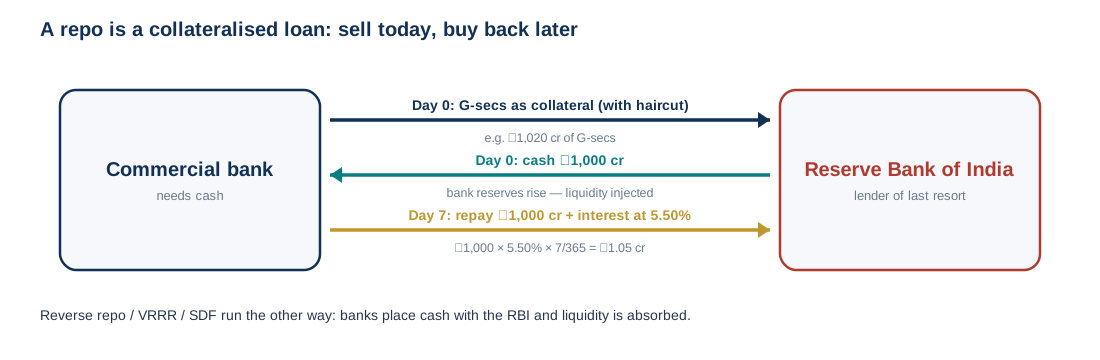
The six-member Monetary Policy Committee (three RBI members and three external members) votes on the repo rate, usually six times a year. On 7 October 2026 it voted unanimously to raise the repo rate by 25 bp to 5.50% and changed its stance from neutral to calibrated tightening; two members preferred to keep the stance neutral.
A bank borrows ₹1,000 crore from the RBI for 7 days at the repo rate of 5.50%.
Interest = ₹1,000 cr × 5.50% × 7 / 365 = ₹1.05 crore
Collateral: G-secs worth a little more than ₹1,000 crore (an illustrative 2% haircut means ≈ ₹1,020 crore), so the RBI is protected if bond prices fall.
Why it matters: when the repo rate rises, borrowing reserves becomes dearer; banks raise the rates they charge one another, then the rates on Treasury bills, commercial paper and certificates of deposit, and eventually deposit and lending rates. Repo-linked loans (EBLR) reset directly — see section 13.
Reverse repo — and why it went quiet
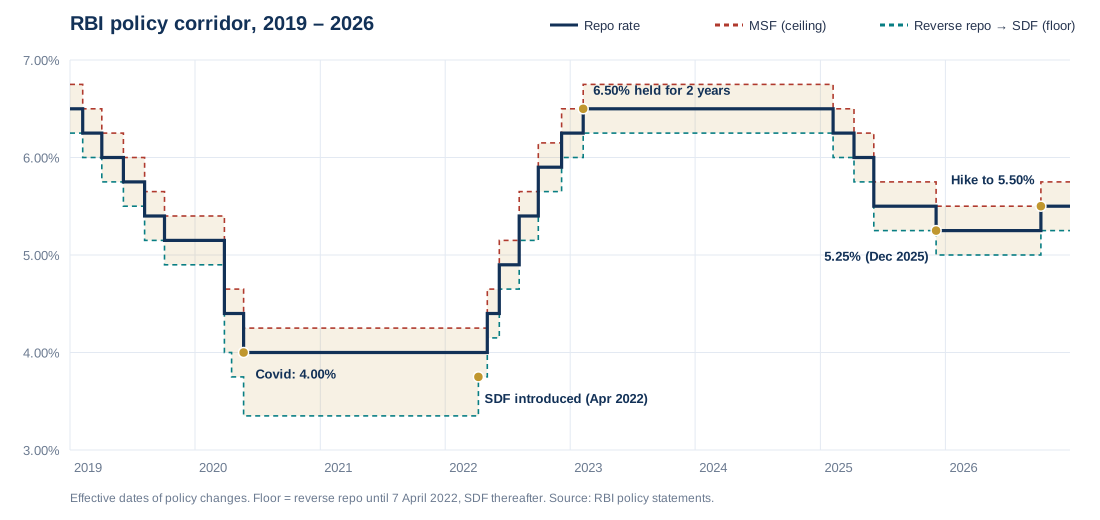
Until April 2022 the fixed-rate reverse repo was the floor of the policy corridor. In the Covid period it was cut to 3.35% — far below the 4% repo rate — to push banks to lend rather than park money. But it had a practical problem: the RBI must hand over G-secs as collateral, and with surplus liquidity running into lakhs of crores it could run short of securities to give.
On 8 April 2022 the RBI introduced the Standing Deposit Facility at 3.75% (repo 4.00% − 25 bp) as the new floor. The fixed-rate reverse repo still exists at 3.35%, but it sits outside the corridor and is used only at the RBI's discretion. When people say “reverse repo” today they usually mean the VRRR auctions in section 10.
Standing Deposit Facility (SDF)
A bank has ₹500 crore of surplus at the end of the day. It deposits it in the SDF at 5.25% overnight.
Interest = ₹500 cr × 5.25% / 365 = ₹7.19 lakh for one night.
No bank would lend in the call market at much less than 5.25% — so the SDF puts a floor under overnight rates.
Why no collateral? The RBI is borrowing from the bank, and the RBI cannot default in rupees. Removing the collateral requirement frees the RBI from needing a stock of G-secs to absorb surplus, which is exactly the constraint that limited the old reverse repo.
Marginal Standing Facility (MSF) and the Bank Rate
A bank borrows ₹200 crore overnight under MSF at 5.75% → interest ₹3.15 lakh.
The same amount in a repo window at 5.50% would cost ₹3.01 lakh.
The 25 bp penalty is small in rupees but signals stress — which is why banks use MSF as a last resort.
The LAF corridor
The repo, SDF and MSF make up the Liquidity Adjustment Facility (LAF). Together they form a symmetric corridor 50 bp wide. In normal times the overnight call rate trades inside it; where it trades inside the corridor tells you whether the system is in surplus or deficit.
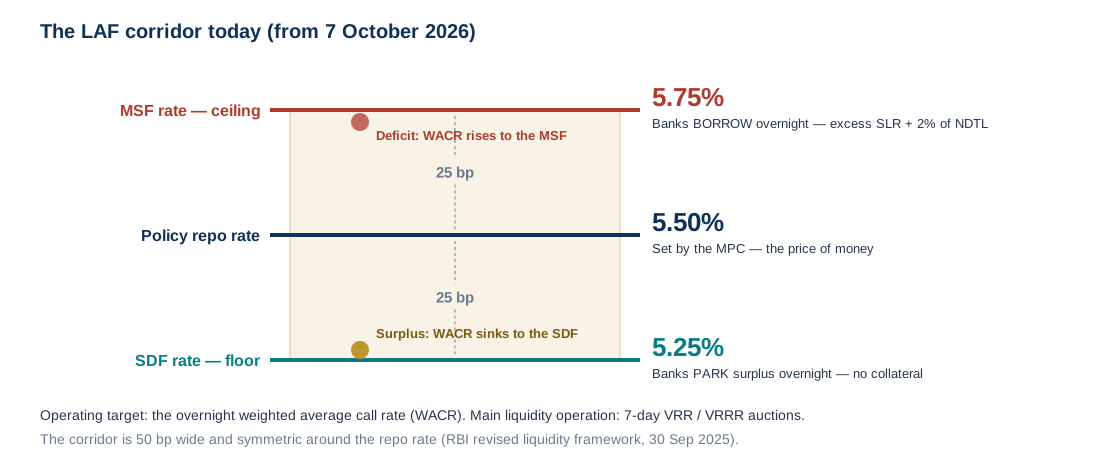
Under the RBI's revised liquidity management framework (30 September 2025), the WACR remains the operating target, the corridor stays symmetric around the repo rate, and the main liquidity operation became the 7-day VRR/VRRR auction (replacing the 14-day auction).
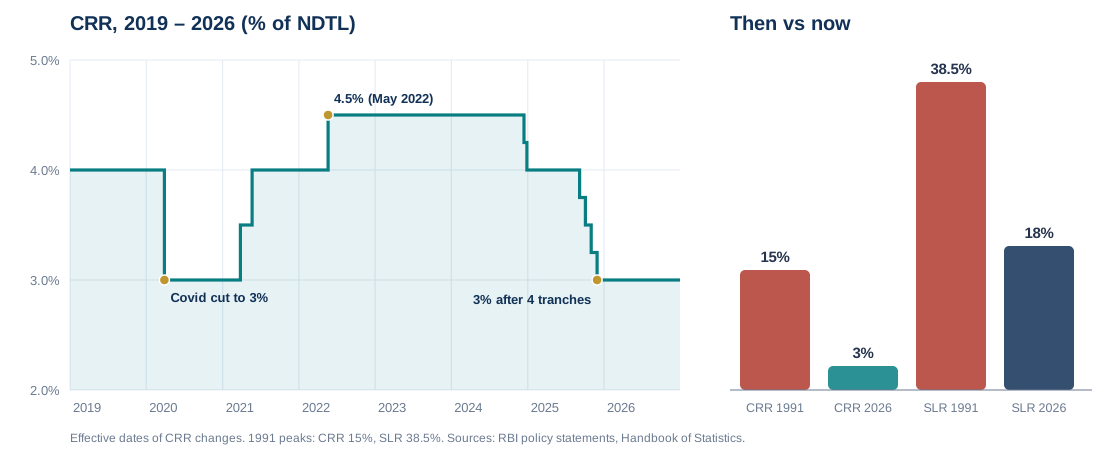
Cash Reserve Ratio (CRR)
Bank NDTL: ₹2,00,000 crore.
CRR at 3% → ₹6,000 crore locked at the RBI; daily minimum (90%) ₹5,400 crore.
When CRR was 4% (before September 2025): ₹8,000 crore. The 100 bp cut released ₹2,000 crore for this bank to lend or invest.
If that money now earns 7% in loans or bonds, the bank gains about ₹140 crore a year — CRR is a tax on banks that falls when CRR falls.
For the whole system, the 100 bp cut announced on 6 June 2025 — delivered in four 25 bp steps from 6 September to 29 November 2025 — released roughly ₹2.5 lakh crore of primary liquidity, according to the RBI. CRR changes are blunt and durable, so the RBI uses them rarely. In 2026, deposits raised through the concessional FCNR(B) swap window were exempted from CRR; the Governor said “nothing is off the table” on CRR, but the October policy left it at 3%.
Statutory Liquidity Ratio (SLR)
Same bank, NDTL ₹2,00,000 crore → SLR requirement ₹36,000 crore in G-secs.
Suppose it holds ₹40,000 crore: ₹4,000 crore is excess SLR, usable for repo or MSF.
In stress it can also dip into required SLR under MSF up to 2% of NDTL = ₹4,000 crore more.
Maximum MSF borrowing capacity ≈ ₹8,000 crore (before haircuts).
Why SLR exists: it is a prudential buffer — a bank that holds G-secs can raise cash quickly — and it creates steady demand for government bonds. It overlaps with the Basel III Liquidity Coverage Ratio: a large part of SLR holdings count as high-quality liquid assets for LCR.
VRR and VRRR auctions
Unlike the standing facilities, auctions let the RBI choose how much and for how long. Since October 2025 the 7-day VRR/VRRR is the main operation, with overnight to 14-day auctions used at the RBI's discretion — usually announced at least a day in advance.
Notified amount: ₹75,000 crore · Bids received: ₹87,993 crore · Accepted: ₹75,026 crore · Cut-off and weighted average rate: 5.24%
Then, SDF = 5.00% and repo = 5.25%. A bank with ₹1,000 crore of surplus for one night earns:
VRRR at 5.24% → ₹14.36 lakh · SDF at 5.00% → ₹13.70 lakh
So banks prefer the VRRR — and the auction pulls money out at a rate close to repo, pushing the call rate back up towards the policy rate.
Auctions do not always work. On 10–11 September 2026, against ₹5 lakh crore notified in a 26-day VRRR, banks bid only ₹60,449 crore; a 4-day auction attracted ₹3.44 lakh crore. When banks prefer to keep funds flexible, the RBI turns to more durable tools.
Beyond the LAF: OMOs, FX swaps and the full map
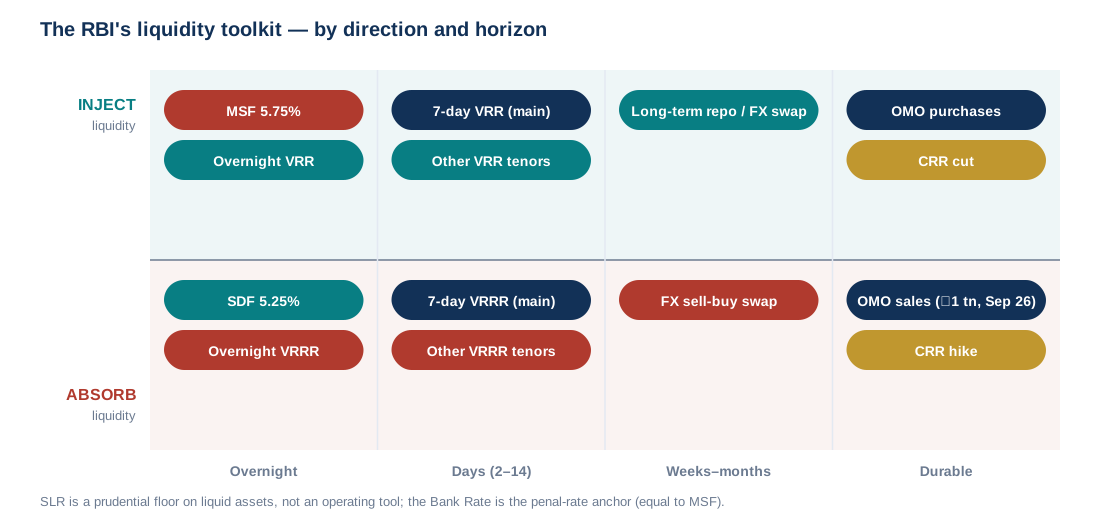
LAF tools handle frictional liquidity — days to weeks. When a surplus or deficit is expected to last, the RBI uses durable tools: open market operations (buying G-secs injects money; selling absorbs it), FX buy–sell swaps, and occasionally CRR changes.
The 2026 liquidity flood — every tool in one story
2026 shows the toolkit working together. A record mobilisation of FCNR(B) foreign-currency deposits — around $127–133 billion — was swapped with the RBI for rupees, flooding banks with reserves.
| Date (2026) | What happened | Tool |
|---|---|---|
| Up to Aug | Repo held at 5.25% (SDF 5.00%, MSF 5.50%) after the December 2025 cut | Repo |
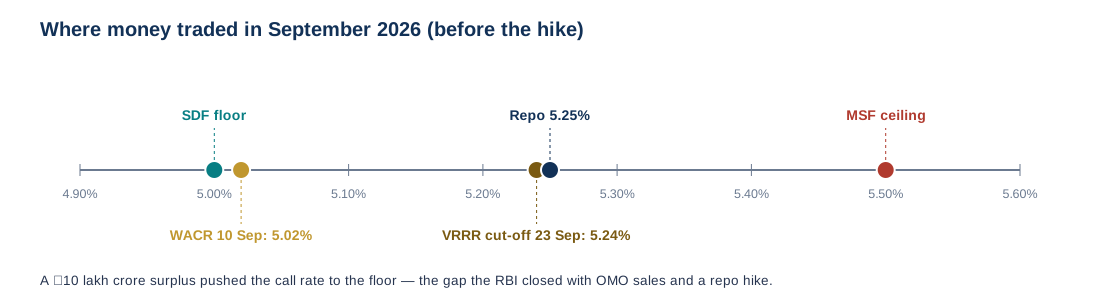
| 10 Sep | Net liquidity surplus ₹10.43 lakh crore; call rate 5.02% — practically at the SDF floor, 23 bp below repo | SDF absorbs |
| 10–11 Sep | 26-day VRRR draws only ₹60,449 crore of bids against ₹5 lakh crore notified | VRRR |
| 17, 21, 28 Sep | ₹1 lakh crore of OMO bond sales (₹50,000 + ₹25,000 + ₹25,000 crore) | OMO sales |
| 23 Sep | Overnight VRRR: ₹75,026 crore accepted at 5.24%; surplus still about ₹4.45 lakh crore | VRRR |
| 7 Oct | Repo raised 25 bp to 5.50%; SDF 5.25%, MSF and Bank Rate 5.75%; stance: calibrated tightening | Repo / corridor |
The lesson: with the call rate stuck at the floor, the effective policy rate was the SDF rate, not the repo rate. The RBI first drained liquidity (VRRR, OMOs) to pull market rates back towards repo, and then raised the whole corridor because inflation was rising — August CPI was 4.8% and the MPC projects 5.2% for 2026-27. The 10-year G-sec yield rose above 7% in September and was around 7.2% after the hike.
From repo rate to your EMI
Since October 2019, new floating-rate retail loans from banks must be linked to an external benchmark — most banks use the repo rate — and must reset at least once every three months. So a repo change reaches these borrowers directly.
Loan ₹50,00,000 · tenure 20 years · rate = repo + spread = 8.00% before the hike.
EMI at 8.00% = ₹41,822 per month.
After the 25 bp hike the rate resets to 8.25% → EMI = ₹42,603, up ₹781 a month — about ₹1.88 lakh over 20 years if the rate stays there.
Alternatively, the bank may keep the EMI and extend the tenure.
Depositors see the other side: fixed-deposit rates tend to rise after hikes, though more slowly, as banks compete for funds.
One-page cheat sheet
| Tool | Who gives / takes cash | Collateral | Tenor | Rate now | Effect |
|---|---|---|---|---|---|
| Repo (policy) | RBI lends to banks | G-secs | Signal; LAF operations | 5.50% | Sets the price of money |
| VRR | RBI lends to banks (auction) | G-secs | Overnight–14 days (7-day main) | Cut-off ≥ repo | Injects |
| VRRR | Banks lend to RBI (auction) | RBI gives G-secs | Overnight–14 days (7-day main) | Cut-off ≤ repo | Absorbs |
| SDF | Banks deposit with RBI | None | Overnight | 5.25% | Absorbs; corridor floor |
| MSF | RBI lends to banks | Excess SLR + 2% of NDTL | Overnight | 5.75% | Injects; corridor ceiling |
| Bank Rate | — | — | — | 5.75% | Penal-rate anchor |
| Fixed reverse repo | Banks lend to RBI | RBI gives G-secs | Discretionary | 3.35% | Dormant |
| CRR | Banks hold cash at RBI | — | Continuous | 3% of NDTL | Cut injects; hike absorbs |
| SLR | Banks hold liquid assets | — | Continuous | 18% of NDTL | Prudential buffer |
| OMO | RBI buys / sells G-secs | Outright | Durable | Market price | Purchase injects; sale absorbs |
Six common confusions
- “The reverse repo is the floor.” Not since April 2022 — the floor is the SDF (5.25%). The fixed reverse repo (3.35%) is outside the corridor.
- “Repo is the rate banks borrow at every day.” Day to day, banks borrow at the call rate and in auctions. The repo rate is the policy signal those rates are steered towards.
- “CRR and SLR are the same thing.” CRR is cash at the RBI earning nothing; SLR is G-secs, cash and gold held by the bank and earning interest.
- “A CRR cut is a rate cut.” It changes the quantity of money, not the policy rate — though more liquidity usually lowers market rates.
- “MSF is for normal funding.” It is a penal, last-resort window; heavy MSF use signals tight liquidity.
- “A hike changes all loan rates immediately.” Repo-linked loans move at their next reset; MCLR loans and fixed deposits adjust with a lag.
Frequently asked questions
Quick answers to the questions students ask most often.
What is the current repo rate in India?
5.50%, effective 7 October 2026, after the MPC raised it by 25 basis points. The SDF rate is 5.25% and the MSF rate and Bank Rate are 5.75%.
What is the difference between repo and reverse repo?
In a repo the RBI lends money to banks against government securities; in a reverse repo banks lend money to the RBI and receive securities. Repo injects liquidity; reverse repo absorbs it.
Why did the SDF replace the reverse repo as the floor?
The SDF lets the RBI absorb surplus without giving collateral, so it is not limited by its stock of government securities. It was introduced on 8 April 2022 at 25 bp below repo and became the floor of the corridor.
What is the difference between CRR and SLR?
CRR (3% of NDTL) is cash kept with the RBI that earns no interest. SLR (18% of NDTL) is held by the bank itself in government securities, cash and gold, and earns interest.
What do VRR and VRRR stand for?
Variable Rate Repo and Variable Rate Reverse Repo. They are auctions in which the RBI injects (VRR) or absorbs (VRRR) a notified amount for a fixed tenor, with the rate set by banks' bids. The 7-day auction is the main operation since October 2025.
When do banks use the MSF?
When they are short of funds overnight and cannot borrow more cheaply elsewhere. They pay repo + 25 bp and can pledge excess SLR securities plus up to 2% of NDTL from their required SLR.
What is the WACR and why does it matter?
The weighted average call rate is the average rate on overnight inter-bank loans. It is the RBI's operating target: the RBI uses liquidity operations to keep it close to the repo rate so that policy changes pass through to the economy.
Why did the RBI raise rates in October 2026?
Inflation was rising (August CPI 4.8%, with a 5.2% projection for 2026-27), growth was strong, and a large liquidity surplus had pushed market rates down to the corridor floor. The MPC raised the repo rate to 5.50% and shifted to a calibrated tightening stance.
How does a repo hike affect my home loan?
If your loan is linked to the repo rate, the rate rises by the same amount at the next reset. On a ₹50 lakh, 20-year loan at 8%, a 25 bp rise lifts the EMI by about ₹781 a month, or the bank may extend the tenure instead.
Where can I check the latest RBI rates?
The RBI website (rbi.org.in) shows current policy rates and reserve ratios on its home page, and publishes each MPC resolution and the minutes two weeks later.
Sources
- RBI — Monetary Policy Statement 2026-27: Resolution of the MPC, 5–7 October 2026
- RBI — Revised Liquidity Management Framework, 30 September 2025
- RBI circular RBI/2026-27/282 on repo, SDF and MSF rates (via TaxGuru)
- SCC Online — October 2026 MPC decisions, projections and vote
- Jainam — RBI Monetary Policy note, October 2026 (rates before and after)
- Key RBI rates as on 7 October 2026 (CRR, SLR, fixed reverse repo)
- Business Standard — ₹1 trillion OMO sales, liquidity surplus and VRRR response, September 2026
- Angel One — overnight VRRR of ₹75,026 crore at 5.24%, 23 September 2026
- RBI — Operationalisation of the Standing Deposit Facility, April 2022
- Business Standard — CRR cut of 100 bp in four tranches, June 2025
- ClearTax — RBI repo rate history
- RBI — Monetary policy statements archive
Educational content, not investment or borrowing advice. Rates are as on 7–9 October 2026 and change at every policy meeting; check rbi.org.in for current values. Worked examples are illustrative and simplified (simple interest, actual/365, no haircuts or taxes unless stated).
The Mountain Path Academy · https://themountainpathacademy.com