1 The market that keeps cash moving
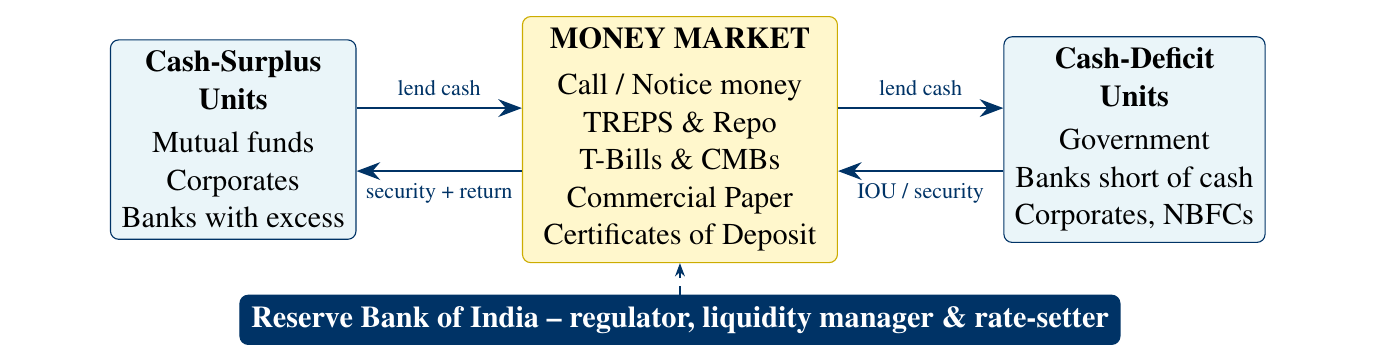
A bank needs funds until tomorrow. A company must finance inventory for three months. A treasury team has cash that will not be needed for 91 days. Money markets connect these short-term borrowing and investment needs.
This guide explains the instruments, the meaning of their quoted rates, and the calculations behind the cash paid today and received later. It follows the Indian market context of the accompanying teaching material, with global day-count comparisons.
A discount security exchanges a price today for face value at maturity. A simple-interest loan exchanges principal today for principal plus interest later. Identify which structure you have before choosing a formula.
All rates and prices in the examples are illustrative, before fees and taxes. They are not live quotes. All examples use one consistent rate setting anchored to the RBI’s August 2026 policy (repo 5.25%), so instrument yields sit sensibly relative to the policy corridor.
2 Money market versus capital market
| Dimension | Money market | Capital market |
|---|---|---|
| Typical horizon | Overnight to one year | Longer-term debt and equity funding |
| Main purpose | Liquidity, working capital and cash-flow timing | Long-term investment and financing |
| Cash-flow pattern | Discount redemption or short-term interest | Coupons, redemption or equity distributions |
| Price sensitivity | Usually lower for comparable credit quality | Often greater for longer-duration debt |
| Risk | Credit, liquidity, rollover and reinvestment risk remain | Risk depends on the security and issuer |
Short maturity reduces the time over which rates can affect a price. It does not make every money-market instrument safe or readily saleable. An unsecured company promise differs fundamentally from a government bill or collateralised financing.
The market includes both tradable securities such as T-bills, CP and CDs, and funding transactions such as call loans and repos. Calling all of them “bonds” obscures their different mechanics.
3 Participants and their cash-management needs
| Participant | Typical use | Question the treasury must answer |
|---|---|---|
| Government | T-bills and CMBs help manage funding and temporary cash mismatches. | When will revenues arrive relative to payments? |
| Banks | Borrow and lend short-term funds; issue CDs; hold liquid securities. | Can cash obligations be met under normal and stressed conditions? |
| Primary dealers | Distribute government securities and finance inventory. | How will the securities position be funded? |
| Companies and NBFCs | Issue CP or invest temporary surplus cash. | Does the financing maturity match the underlying cash generation? |
| Mutual funds and institutional investors | Invest through eligible instruments and manage redemptions. | How much can be converted to cash without a material price concession? |
| RBI | Conduct monetary operations and manage banking-system liquidity. | Are overnight conditions consistent with the policy stance? |
Eligibility is instrument-specific. Participation in one market does not automatically grant access to every other segment. RBI regulates key money-market activities, while participants such as mutual funds also operate under their own regulatory frameworks.
4 The RBI operating framework
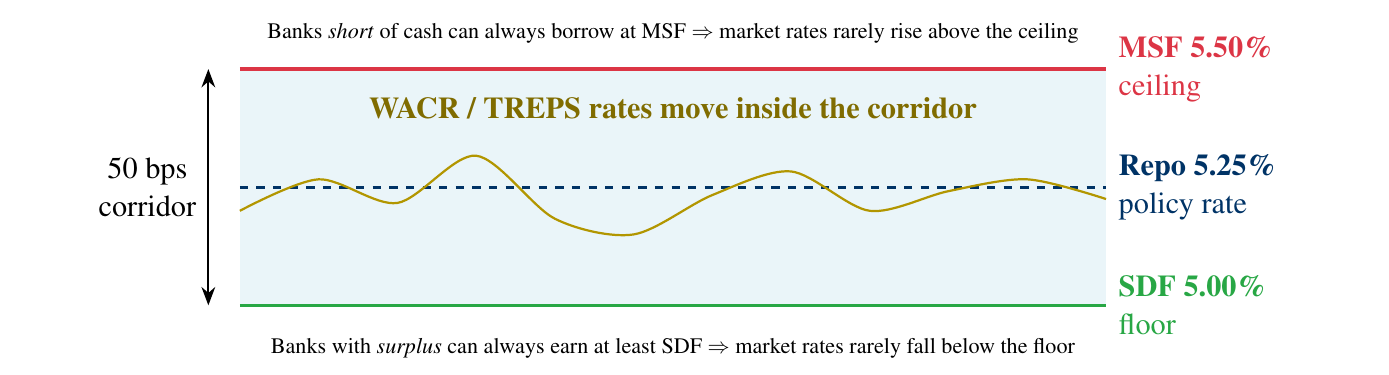
The weighted average call rate, or WACR, is the operating target of Indian monetary policy. Liquidity operations seek to align it with the policy repo rate. The standing deposit facility (SDF) forms the corridor’s floor and the marginal standing facility (MSF) its ceiling.
Variable-rate operations can inject or absorb liquidity. The effect depends on the amount, tenor, market conditions and access to facilities. Corridor terminology does not mean every transaction or every CP/CD yield must remain inside those bounds.
Reserve requirements and liquidity regulations also shape demand for cash and securities. Their levels can change; this guide focuses on the mechanism. For reference, the RBI MPC decision of August 2026 kept the policy repo rate at 5.25% (SDF 5.00%, MSF 5.50%) with a neutral stance; check the RBI website for later decisions.
Reference: RBI — Monetary policy operating framework.
5 Treasury bills and cash management bills
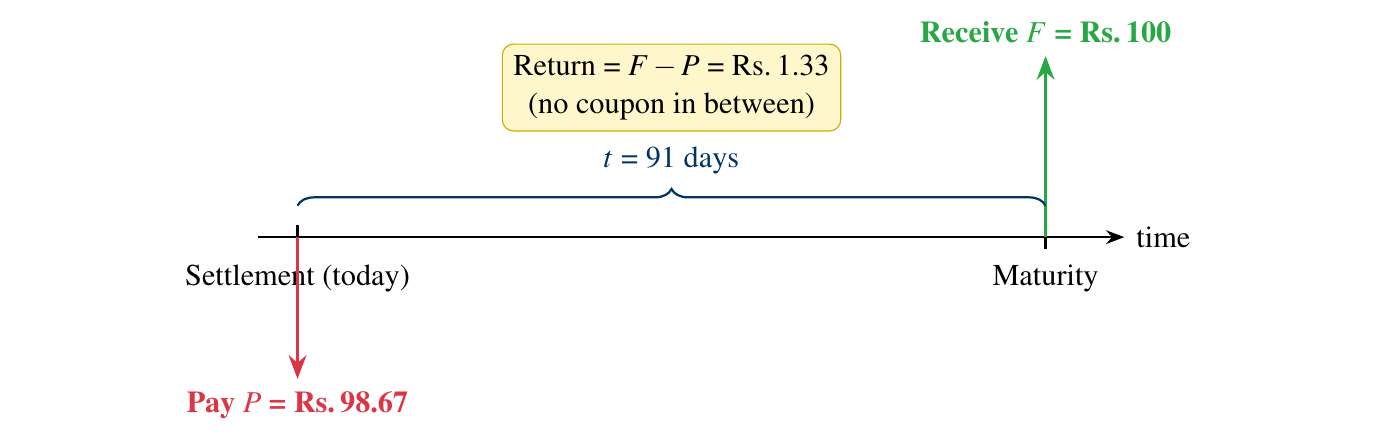
Treasury bills are short-term Government of India securities with no periodic coupon. The standard original tenors are 91, 182 and 364 days. At a positive yield, the investor buys below face value and receives face value at maturity.
Cash management bills meet temporary government cash-flow mismatches and have original maturities below 91 days. Their irregular tenors distinguish them from the standard T-bill cycle.
Indian T-bill auction results report a cut-off price and its implicit yield. A security issued at a discount is not necessarily quoted using a bank discount rate. The distinction matters because the two rate formulas have different denominators.
Government credit provides the domestic sovereign benchmark, but an early sale can still produce a gain or loss. Because a bill has no periodic coupon, it normally has no separate accrued-coupon addition of the kind explained in the clean and dirty price guide.
Reference: RBI — Government Securities Market primer.
6 Commercial paper, CDs and trade bills
| Instrument | Economic structure | What to examine |
|---|---|---|
| Commercial paper (CP) | Short-term unsecured funding by eligible issuers; commonly issued at a discount. | Issuer repayment capacity, rating, liquidity and refinancing dependence. |
| Certificate of deposit (CD) | Negotiable money-market bank funding; the examples here use discount CDs. | Bank credit, transferability, maturity and secondary-market depth. |
| Commercial / trade bill | Financing against an underlying trade receivable or bill of exchange. | Buyer acceptance, transaction quality, recourse and payment timing. |
A strong credit rating is useful information, not a repayment guarantee. Likewise, a tradable CD is not interchangeable with a conventional fixed deposit: transferability and applicable terms must be understood.
The RBI’s 2021 bank-CD directions specify an issuance tenor from seven days to one year. Do not extend this statement indiscriminately to every financial-institution funding product. For CP, check the applicable RBI directions, issuer eligibility, denomination and disclosure requirements before a live transaction.
TReDS supports financing of eligible MSME trade receivables. It is distinct from TREPS, the tri-party repo dealing system. Similar acronyms describe different underlying transactions.
Reference: RBI — Certificate of Deposit Directions.
7 Call money, repo and TREPS
Call money is overnight unsecured funding. Notice money covers more than overnight and up to 14 days; term money extends beyond 14 days within the short-term market. Access is restricted to eligible institutions under RBI rules.
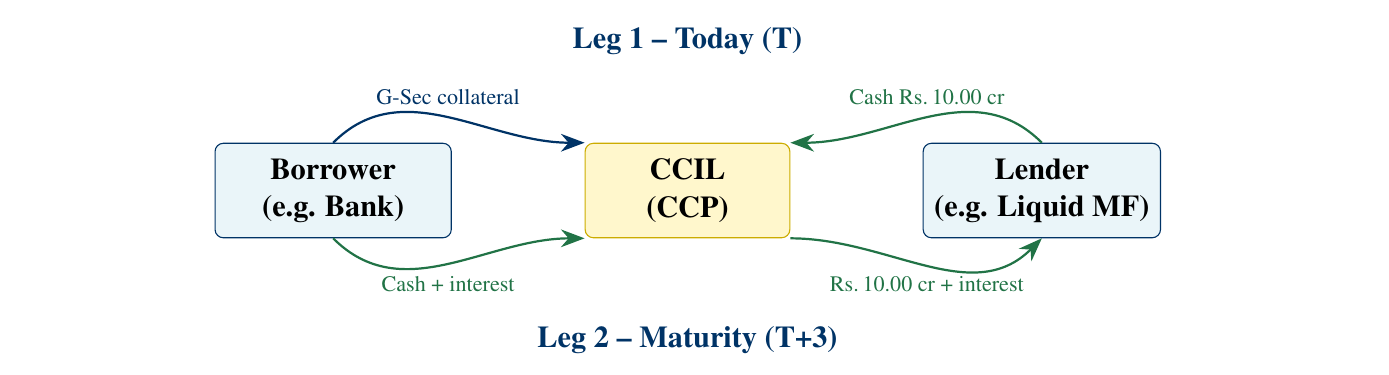
A repo is a sale of securities with an agreement to repurchase them. Economically, it provides collateralised funding. The cash borrower pays financing interest; the lender holds rights in collateral subject to the arrangement.
Borrower → securities → lender
Securities return to borrower
In Indian TREPS, CCIL acts as central counterparty and tri-party agent, facilitating collateral and settlement arrangements. A haircut reduces the borrowing value assigned to collateral. This helps manage exposure but does not eliminate all credit, market, liquidity or operational risk.
Operational distinction: CCIL describes the first-leg consideration as second-leg consideration discounted at the repo rate. Our teaching calculator starts with the cash principal advanced in the first leg, then calculates repayment. Do not substitute a platform’s second-leg order amount for that input.
Reference: CCIL — Tri-party repo FAQs.
8 Discount rates and investment yields
| Symbol | Meaning |
|---|---|
| F | Face value / amount repaid at maturity |
| P | Cash price paid at settlement |
| t | Actual days from settlement to maturity |
| B | Annualisation basis: 365 or 360 |
| d | Annualised discount rate, measured against face value |
| y | Annualised simple investment yield, measured against price |
Discount rate d = (F − P) / F × B/t
Simple yield y = (F − P) / P × B/t
For a positive discount, F exceeds P. Dividing the same cash gain by the larger face amount produces a smaller rate. On the same basis and tenor, d is therefore below y. The yield measures return on the money invested; neither quoted rate is automatically a realised one-year return.
Price from simple yield: P = F / (1 + y × t/B)
y = d / (1 − d × t/B)
d = y / (1 + y × t/B)
A 6.50% discount quote and a 6.50% simple-yield quote imply different prices. Confirm the quotation type before putting a rate into a formula.
9 Day counts and effective annual return
The Indian examples use Actual/365 Fixed: actual calendar days in the numerator and 365 in the denominator, including leap years. Actual/360 also uses actual calendar days. It is not the same as 30/360.
y360 = y365 × 360/365
These conversions preserve the same simple holding-period return over the same days. They do not convert a discount rate into an investment yield. A 5.00% Actual/360 simple yield becomes 5.0694% on Actual/365.
For a consistent 365-day effective annual comparison:
= (1 + yB × t/B)365/t − 1
The quote basis B determines the holding-period return; the exponent here always annualises to 365 days. EAY assumes repetition of the same return with reinvestment. It is a comparison measure, not a promise that the rate will remain available.
For positive yields with t < 365 on a 365-day quote basis, d < y < EAY. At t = 365, EAY = y. Thus a strict ranking is not universal.
“Bond-equivalent yield” is convention-dependent. A simple 365-day money-market yield should not be treated automatically as a semiannual-compounded bond YTM. Cross-currency comparisons additionally require FX risk and hedging costs.
10 Worked example: a 91-day T-bill
Using the PDF’s inputs, buy at ₹98.67 per ₹100 face and hold for 91 days. The maturity gain is ₹1.33.
| Measure | Calculation | Recalculated result |
|---|---|---|
| Discount rate | 1.33 / 100 × 365/91 | 5.3346% |
| Simple investment yield | 1.33 / 98.67 × 365/91 | 5.4065% |
| Effective annual yield | (100 / 98.67)^(365/91) − 1 | 5.5172% |
A ₹10 lakh face position costs ₹9,86,700 and receives ₹10,00,000 at maturity, assuming payment in full. The ₹13,300 gain is earned over 91 days, not one year.
A separate discount-quotation exercise
Suppose a 91-day bill is instead quoted at a discount rate d = 5.40%, with B = 365. This gives P = ₹98.65369863, y = 5.4737% and EAY = 5.5872%. Use this as a hypothetical discount quote, not as a description of an Indian auction’s implicit-yield convention.
Sources: PDF worked examples 1–2. Results use unrounded inputs.
11 Worked examples: CP issuance and a bank CD
A. ₹5 crore face value of 180-day CP
Investors require a simple yield of 6.40% on Actual/365 — about 95 bps over the 182-day T-bill (5.45%).
| Measure | Result |
|---|---|
| Price per 100 | 96.94040157 |
| Cash proceeds | ₹4,84,70,200.79 |
| Discount / financing cost over 180 days | ₹15,29,799.21 |
| Equivalent discount rate | 6.2042% |
| Equivalent Actual/360 simple yield | 6.3123% |
| 365-day EAY | 6.5038% |
Issuing ₹5 crore face value raises less than ₹5 crore cash. If the company instead needs ₹5 crore cash today, required face value is 50,000,000 × (1 + 0.064 × 180/365), before charges.
B. ₹1 crore face value of a 182-day CD
Using the PDF’s 6.05% simple yield, price = 10,000,000 / (1 + 0.0605 × 182/365) = ₹97,07,162.82. Income at maturity is ₹2,92,837.18, and EAY is 6.1418%.
These are contractual cash-flow calculations, not assessments of a particular company or bank’s creditworthiness.
Sources: PDF worked examples 3–4 (workbook model 2 structure, rebased to the August 2026 rate setting). All cash amounts are recalculated.
12 Worked examples: repo and overnight money
A. Three-day financing across a weekend
Advance ₹10 crore cash at a 5.15% annual simple rate for three calendar days — inside the SDF–MSF corridor (5.00%–5.50%).
| Measure | Result |
|---|---|
| Interest for three days | ₹42,328.77 |
| Second-leg repayment | ₹10,00,42,328.77 |
| Collateral value for principal at an illustrative 5% haircut | ₹10,52,63,157.89 |
The haircut illustration uses cash = collateral value × (1 − haircut). Therefore collateral = cash/(1 − haircut), not cash × (1 + haircut). Actual margin obligations may include interest exposure, initial margin, valuation changes and other rules; 5% is an assumption, not a quoted CCIL requirement.
B. ₹25 crore overnight call loan at 5.30%
A 10-basis-point rate change alters one day’s interest by ₹684.93. A basis point is 0.01 percentage point; 10 bps equals 0.001 as a decimal rate.
Sources: PDF worked examples 5–6 (workbook model 3 structure, rebased to the August 2026 rate setting).
13 Interactive pricing and funding laboratory
Load a source example or change the inputs. Quoted rates are annual percentages; prices are per ₹100 face. Results exclude fees, taxes and default.
Discount-security calculator
Repo / simple-interest funding calculator
Funding calculator uses Actual/365. Collateral output covers the principal using the entered haircut only; it is not a full clearing-margin calculation. Discount-security calculator supports positive prices and non-negative rates up to 100%, with maturities of 1–365 days.
14 Early sale, pull to par and rate risk
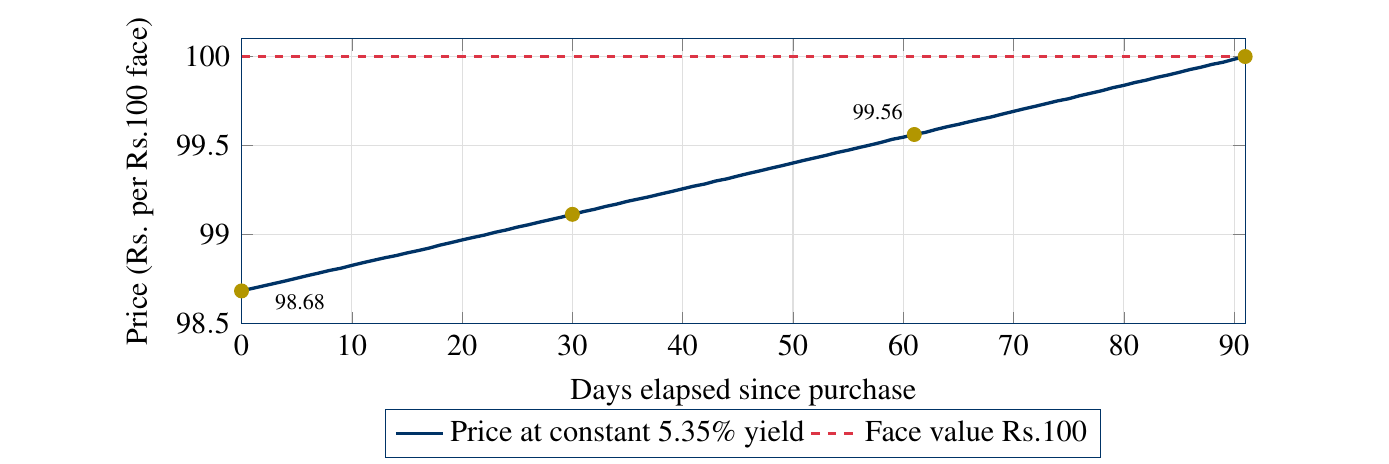
The PDF considers selling the 91-day bill after 30 days. With 61 days remaining and a new simple yield of 5.20%:
30-day return = Sale price / 98.67 − 1 = 0.4748%
Simple annualised realised return = 5.7763%
The original hold-to-maturity yield does not guarantee the return on an early sale. The exit price uses the market yield for the remaining maturity, and transaction costs reduce the realised return.
Try an early-sale scenario
Shorter maturity usually means less rate sensitivity, not zero sensitivity. At fixed remaining tenor, a higher required yield produces a lower bill price. Pull to par describes the passage-of-time effect under unchanged assumptions.
15 Compare instruments on the same basis
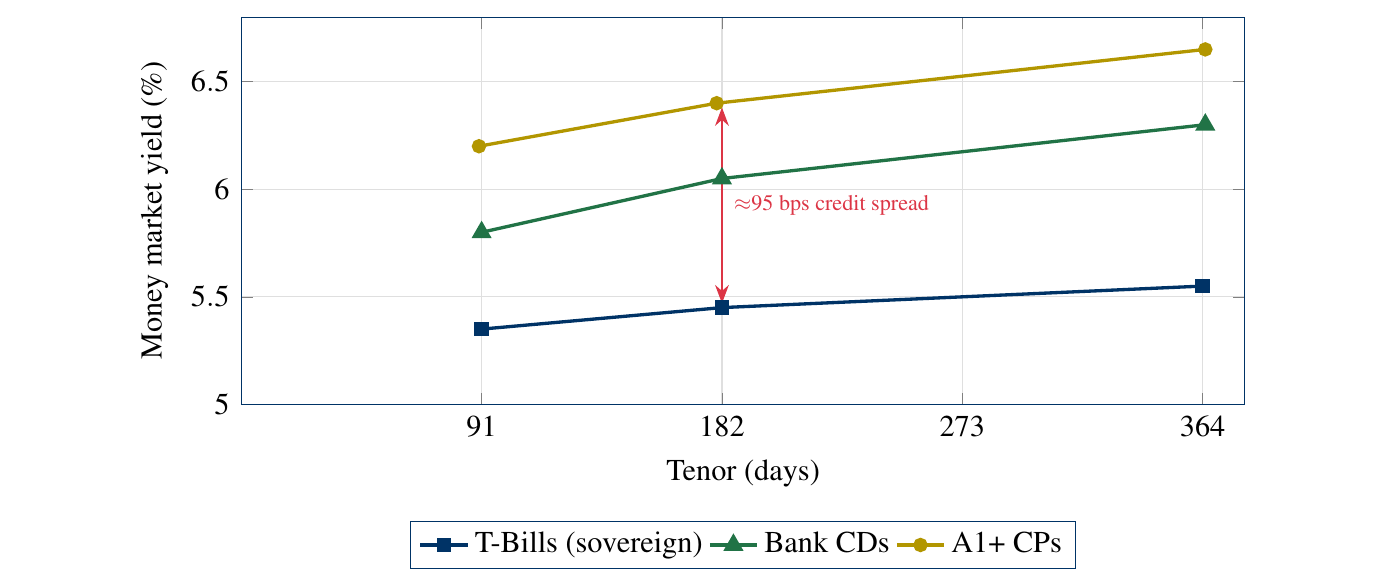
The following uses the PDF’s illustrative Actual/365 simple yields, consistent with the August 2026 rate setting. T-bill yields are shown the way Indian auction results report them: as the implicit yield on the price.
| Instrument | Days | Input quote | Price / 100 | Simple yield 365 | EAY 365 |
|---|---|---|---|---|---|
| T-bill | 91 | Simple yield: 5.3500% | 98.683721 | 5.3500% | 5.4584% |
| T-bill | 182 | Simple yield: 5.4500% | 97.354362 | 5.4500% | 5.5245% |
| T-bill | 364 | Simple yield: 5.5500% | 94.755479 | 5.5500% | 5.5504% |
| CP | 90 | Simple yield: 6.2000% | 98.494252 | 6.2000% | 6.3463% |
| Bank CD | 180 | Simple yield: 6.0500% | 97.102876 | 6.0500% | 6.1428% |
| Bank CD | 365 | Simple yield: 6.3000% | 94.073377 | 6.3000% | 6.3000% |
Compare maturity, currency, cash-flow structure and day-count convention before judging a spread. In particular, subtracting a discount quote from a simple yield produces a misleading comparison.
For near-matched maturities, the 180-day CP at 6.40% (Section 11) against the 182-day T-bill at 5.45% gives a spread of about 95 bps — the same gap highlighted in Figure 6. Compare yields with yields: measuring a spread against a discount quote would distort it.
A spread can reflect credit risk, liquidity, supply and demand, tax treatment and other market effects. It is not a pure default probability. Yield curves can be upward-sloping, flat or inverted; CP and CD rankings are not fixed laws.
16 Excel formulas you can audit
For a compact model, put face value in B2, price in B3, days in B4 and quote basis in B5. Enter annual rates as percentages. Use full precision internally.
| Output | Formula |
|---|---|
| Holding-period return | =(B2-B3)/B3 |
| Discount rate | =(B2-B3)/B2*B5/B4 |
| Simple yield | =(B2-B3)/B3*B5/B4 |
| 365-day effective annual yield | =(B2/B3)^(365/B4)-1 |
| Price from discount rate in B6 | =B2*(1-B6*B4/B5) |
| Price from simple yield in B7 | =B2/(1+B7*B4/B5) |
| Interest: principal C2, rate C3, days C4 | =C2*C3*C4/365 |
| Collateral: cash C2, haircut C5 (enter as 5% or 0.05, not 5) | =C2/(1-C5) |
A dated 91-day example
Put =DATE(2026,9,25) in D2 and =DATE(2026,12,25) in D3. The difference is 91 days.
| Function | Example |
|---|---|
| Days | =DAYS(D3,D2) |
| Discount rate from price | =DISC(D2,D3,98.67,100,3) |
| Investment yield from price | =YIELDDISC(D2,D3,98.67,100,3) |
| Price from a 5.40% discount rate | =PRICEDISC(D2,D3,5.4%,100,3) |
| Year fraction | =YEARFRAC(D2,D3,3) |
Basis 3 means Actual/365; basis 2 means Actual/360. PRICEDISC expects a discount rate, not a simple investment yield. For price from yield, use the explicit denominator formula.
US Treasury-bill functions hard-code the US Actual/360 convention and have no selectable basis argument. For example, =TBILLPRICE(D2,D3,5.4%) returns 98.6350, whereas the Actual/365 PRICEDISC above gives 98.6537. Do not treat TBILLPRICE, TBILLYIELD or TBILLEQ as generic Indian pricing formulas. Likewise, use the explicit power formula for EAY rather than passing a fractional number of periods to EFFECT.
Reference: Microsoft — YIELDDISC.
17 Why money markets matter for the economy
Money-market rates are an early channel of monetary-policy transmission. Changes in short-term funding conditions influence deposit pricing, working-capital finance and lending decisions. Transmission is neither instantaneous nor identical across borrowers.
For a corporate treasury, the practical goal is to match investment maturities to known outflows while maintaining a buffer for uncertainty. For a bank or NBFC, asset–liability management also asks whether funding remains available when markets are stressed.
A maturity ladder spreads cash receipts across dates. It can reduce dependence on a single refinancing or reinvestment date, but cannot guarantee liquidity or eliminate issuer exposure.

18 Risks and the questions that reveal them
| Risk | What can go wrong? | Question to ask |
|---|---|---|
| Credit | Issuer or counterparty fails to pay. | What supports repayment beyond the rating? |
| Liquidity | Sale requires a discount or cannot be completed in time. | Who buys this paper during stress? |
| Rollover | Maturing debt cannot be replaced at an acceptable cost. | Can the borrower repay without issuing new paper? |
| Interest-rate | Required yields rise and market prices fall. | What happens if the position must be sold early? |
| Reinvestment | Maturing cash earns a lower rate on renewal. | Is the apparent EAY dependent on repeated reinvestment? |
| Collateral and operational | Collateral loses value, margins increase or settlement fails. | What assets and cash are available to meet additional obligations? |
Funding long-lived assets with repeatedly renewed short-term CP creates a maturity mismatch. A profitable borrower can still face a liquidity crisis if refinancing stops.
Money-market mutual funds hold portfolios of instruments rather than guaranteeing a deposit-like return. Net asset values can change, and daily redemption arrangements do not make every underlying security instantly liquid. Avoid treating “short”, “highly rated” and “risk-free” as synonyms.
19 Practice questions and worked answers
1. Buy a 182-day bill at 97.35 per 100. What is its Actual/365 simple yield?
(100 − 97.35)/97.35 × 365/182 = 5.4592%.
2. Issue ₹10 crore face of 90-day CP at a 6.20% simple yield. How much cash is raised?
Proceeds = 100,000,000/(1 + 0.062 × 90/365) = ₹9,84,94,252.25. Discount cost = ₹15,05,747.75.
3. A 364-day bill has a 5.50% discount quote on Actual/365. Find price and investment yield.
Price = 94.51506849 per 100. Simple yield = 5.8192%.
4. Convert a 5.00% Actual/360 simple yield to Actual/365.
5% × 365/360 = 5.0694%. This preserves the same holding-period return; it does not adjust currency risk.
5. Lend ₹50 crore overnight at 5.10%, Actual/365. Calculate interest.
500,000,000 × 0.051/365 = ₹69,863.01.
6. Is effective annual yield always higher than simple yield?
No. With a 365-day investment and a 365-day quote basis, they are equal. The strict inequality requires the relevant positive-rate, shorter-period assumptions.
7. Does 5% collateral haircut mean collateral equals cash multiplied by 1.05?
No. If the haircut applies to collateral market value, collateral = cash/0.95. This is approximately 1.05263 times cash before other margin requirements.
8. Does a zero-coupon T-bill require accrued coupon interest to be added to its price?
Normally no. Its discount is reflected in its value; there is no periodic coupon accrual to add separately.
20 References, notation and next steps
Teaching sources: All About Money Markets, Prof. V. Ravichandran, especially instruments, pricing mathematics, worked examples and practice questions; and Money Market Fixed Income Securities — Excel Workbook (23 September 2026), especially “Quotation & Pricing Conventions” and “Worked Examples & Calculations”.
All outputs are recalculated from unrounded inputs. Policy rates cited are from the RBI MPC decision of August 2026; all instrument prices and yields are illustrative and rebased to that rate setting. Administrative workbook logs are excluded. Fixed liquidity rankings and unsupported guarantees are not used as current facts.
- RBI — Government Securities Market primer
- RBI — Certificate of Deposit Directions
- RBI — Monetary policy framework
- CCIL — Tri-party repo settlement FAQs
- Microsoft — YIELDDISC function
| Abbreviation | Meaning |
|---|---|
| ALM | Asset–liability management |
| CP / CD / CMB | Commercial paper / certificate of deposit / cash management bill |
| WACR | Weighted average call rate |
| SDF / MSF | Standing deposit facility / marginal standing facility |
| MMY / EAY | Money-market yield / effective annual yield |
| TREPS / TReDS | Tri-party repo dealing system / Trade Receivables Discounting System |
Continue with Accrued Interest, Clean Price & Dirty Price, Bond Prices and Yields, or Spot Rates vs Forward Rates.