What is a convertible bond?
A comprehensive guide to features, valuation, risk and CFA-style applications
Debt income with a choice to become an equity investor
A conventional convertible bond gives its holder the contractual right to exchange the bond for a specified number of shares. Until conversion, the investor remains a creditor and receives the promised bond cash flows, subject to default. On conversion, the investor gives up the bond claim and becomes a shareholder.
Example: A company issues a bond with face value INR 1,000, a 4% annual coupon and the right to convert into 20 shares. The investor receives INR 40 annually while the bond remains outstanding. If the share price reaches INR 70, the shares obtainable through conversion are worth INR 1,400. If the share price is INR 30, conversion produces only INR 600, so redemption may be preferable, provided the issuer can pay.
Convertible bonds at a glance
Equity opportunity.
A choice to convert is valuable. A debt claim can support value. Neither removes issuer credit risk.
Continue, convert, or exercise a contractual put. On a call, compare redemption with conversion.
The bond floor moves with rates and credit. Conversion value and today’s fair value are different.
Features and contract terms
Read the indenture before choosing a pricing model
| Feature | Meaning and pricing implication |
|---|---|
| Face value and maturity | Amount and date of contractual redemption if the bond remains outstanding and the issuer pays. |
| Coupon | Fixed, floating or zero. Usually lower than an otherwise comparable non-convertible issue because conversion is valuable. |
| Conversion ratio (CR) | Number of shares delivered for each bond; may change under specified adjustments. |
| Conversion price (K) | Contractual reference price, commonly face value divided by CR. Distinct from market conversion price. |
| Exercise window | Conversion may be permitted continuously, on dates, or only if conditions are satisfied. |
| Settlement method | Physical shares, cash or a combination. Cash settlement changes cash-flow and credit exposure. |
| Issuer call | Issuer may redeem at contractual prices on eligible dates; conversion rights usually survive during notice. |
| Investor put | Holder may demand repayment on eligible dates, often at a specified premium to face. |
| Seniority and security | Determine creditor ranking and recovery; conversion does not guarantee repayment. |
| Anti-dilution protection | Adjustments may address splits, rights issues and some dividends; protection is contract-specific. |
| Change of control | May provide a put or extra conversion shares (make-whole protection). |
| Soft call / hard call | Soft call requires an equity-price or other trigger; hard call has no such equity trigger once exercisable. |
A soft-call condition might require the stock to exceed 130% of the conversion price for 20 of 30 trading days. This is a hypothetical clause: the exact observation period and notice terms must be modelled. A trigger permitting conversion is different from a trigger permitting an issuer call.
Why issue or buy a convertible?
The financing benefit is exchanged for a valuable investor option
Issuer perspective
A growing company may obtain a lower cash coupon than on straight debt. If investors later convert, the debt is extinguished and new equity is issued. Conversion can reduce future refinancing needs, but it dilutes existing shareholders. Issuing a convertible does not ensure conversion: if the share price stays low, principal still needs to be funded at maturity.
Compare a 4% convertible with an otherwise similar 8% straight bond on INR 1,000 face. The annual cash coupon saving is INR 40. That saving is compensation for granting conversion rights; it is not free financing. The actual comparison must also consider issue price, covenants, expenses and dilution.
Investor perspective
The holder obtains contractual income and potential participation in equity appreciation. The debt claim can support value when conversion is unattractive, although that support weakens if yields or credit spreads rise. Relative to buying shares directly, the investor generally pays a premium for this combination and initially receives less equity sensitivity.
| Security | Investor position | Principal trade-off |
|---|---|---|
| Straight bond | Creditor throughout | Income and credit risk; limited equity upside |
| Ordinary shares | Owner immediately | Direct upside and dividends; residual claim |
| Convertible bond | Creditor until conversion | Lower coupon than comparable straight debt; optional equity exposure |
Lifecycle illustration
Issue -> receive coupons while outstanding -> compare continuation, conversion and available put -> respond to any issuer call -> convert or receive contractual redemption. Conversion ordinarily ends entitlement to later coupons. Accrued interest and the final coupon depend on the indenture.
Essential conversion measures
Worked case A: use one consistent price and unit convention
Assume face F = INR 1,000; contractual conversion price K = INR 50; stock price S = INR 48; convertible market price P = INR 1,100; annual coupon = INR 40. Assume settlement immediately after a coupon date, so accrued interest is zero.
| Measure | Formula | Worked result |
|---|---|---|
| Conversion ratio | CR = F / K | 1,000 / 50 = 20 shares |
| Conversion value / parity | CV = CR x S | 20 x 48 = INR 960 |
| Market conversion price | MCP = P / CR | 1,100 / 20 = INR 55 per share |
| Premium per share | MCP - S | 55 - 48 = INR 7 |
| Market conversion premium ratio | (MCP / S) - 1 = P / CV - 1 | 1,100 / 960 - 1 = 14.5833% |
| Premium over parity (amount) | P - CV | 1,100 - 960 = INR 140 |
| Current yield | Annual coupon / P | 40 / 1,100 = 3.6364% |
Interpretation
Buying the bond and converting immediately costs an effective INR 55 per share, while shares trade at INR 48. The INR 7 difference per share is the conversion premium. This does not imply the shares must rise immediately: the investor is also buying income, future flexibility and a debt claim.
The contractual conversion price stays INR 50 unless adjusted by the terms. The market conversion price changes whenever P changes. Confusing the two is a common error.
If prices are quoted per 100 of face, a quote of 110 means INR 1,100 for a face amount of INR 1,000. Never divide the quote 110 by a CR defined per INR 1,000 bond. Use matching clean/dirty conventions and account for accrued interest in an actual settlement comparison.
Straight value and the bond floor
Worked case B: quantify the debt support
Retain F = INR 1,000 and annual coupon INR 40. Assume five years remain and the required annual yield on comparable option-free debt is 8%. Use annual compounding and no default beyond the credit risk reflected in this illustrative yield.
| Year | Cash flow | PV at 8% |
|---|---|---|
| 1 | 40 | 37.04 |
| 2 | 40 | 34.29 |
| 3 | 40 | 31.75 |
| 4 | 40 | 29.40 |
| 5 | 1,040 | 707.81 |
| Total | 840.29 |
For a plain, freely convertible, non-callable instrument, a useful theoretical lower benchmark is the greater of straight value and immediate conversion value: max(840.29, 960) = INR 960. The observed INR 1,100 contains value above that benchmark.
The amount paid above straight value is INR 259.71. A fall from INR 1,100 to the current straight value is a 23.6099% decline, calculated as (P - B) / P. This percentage is different from the 30.9069% premium because its denominator differs.
A floor that can move
At a 12% comparable debt yield, straight value falls to INR 711.62. At 16%, it falls to INR 607.08. Stock weakness and spread widening can happen together. The original floor is therefore not a guaranteed exit price. For callable, restricted-conversion or distressed issues, apply the actual exercise rights and credit assumptions rather than a universal max(B, CV) rule.
Payoff and return illustration
Maturity value is different from today's fair value
Assume conversion only at maturity, no call or put, no default, F = 1,000 and CR = 20. Excluding coupons, the final value is max(1,000, 20 x terminal stock price). The conversion threshold is INR 50.
| Stock at maturity | Conversion value | Choice / final value |
|---|---|---|
| 30 | 600 | Redeem / 1,000 |
| 50 | 1,000 | Indifferent / 1,000 |
| 70 | 1,400 | Convert / 1,400 |
If purchased for INR 1,100 and held for five years with five INR 40 coupons, undiscounted profit is 1,000 + 200 - 1,100 = INR 100 when the stock ends at INR 30, and INR 500 when it ends at INR 70. These are cumulative cash profits, not annualized returns. They assume the final coupon is received under either choice.
Before maturity, time value can make holding the bond better than immediate conversion even when parity exceeds face. A terminal payoff diagram must not be presented as a current-price curve. Default, calls, puts and conversion restrictions change the payoff.
Component-based valuation
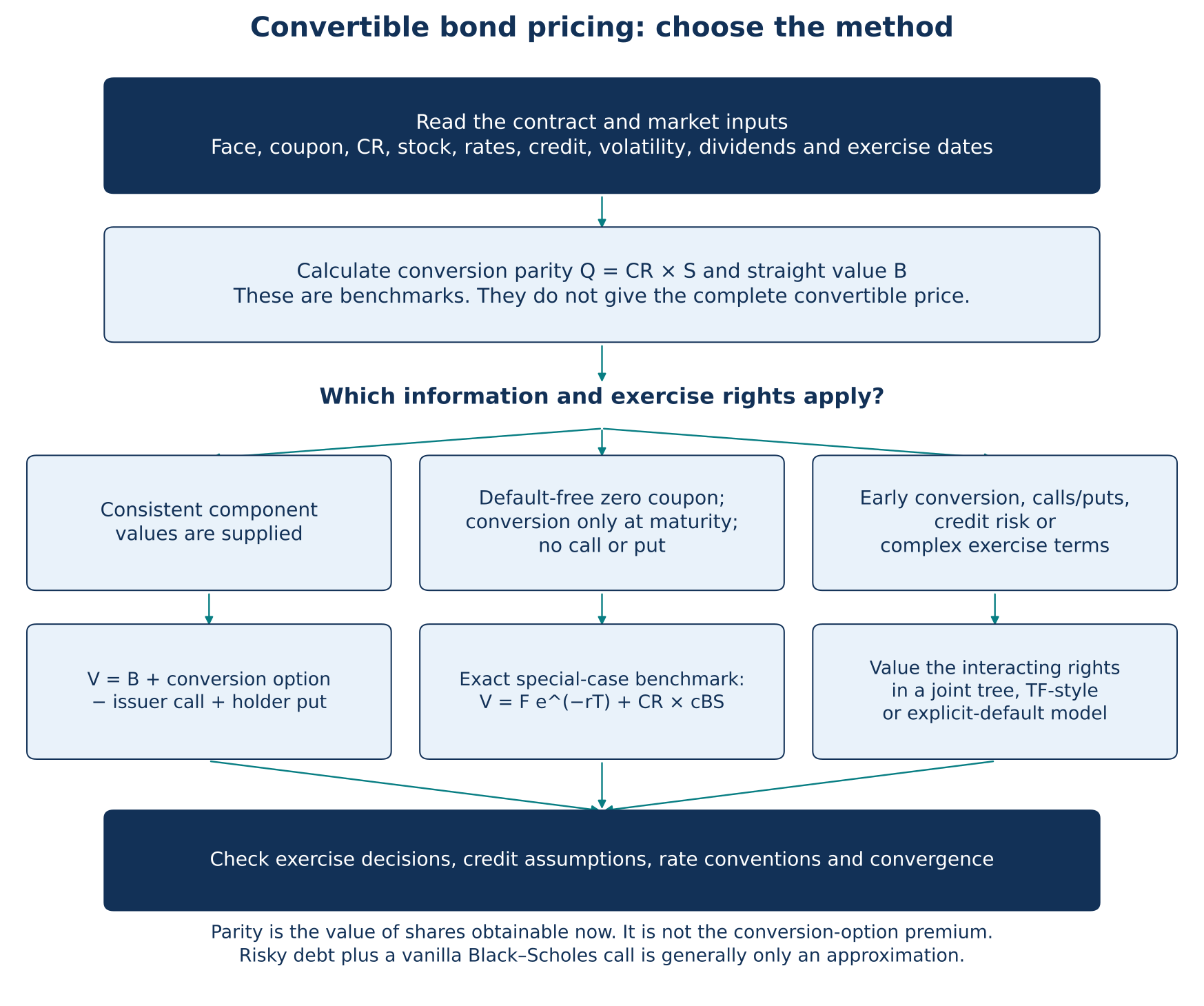
Start with who owns each option
B is the straight debt component. The conversion right benefits the investor and adds value. The issuer call benefits the issuer and subtracts investor value. A holder put adds value. The CFA framework uses this decomposition to organize embedded-option analysis. [1]
| Variant | Component representation |
|---|---|
| Plain convertible | B + C_equity |
| Callable convertible | B + C_equity - C_issuer |
| Puttable convertible | B + C_equity + P_holder |
| Callable and puttable | B + C_equity - C_issuer + P_holder |
Worked case C: given consistent component values
Suppose a model supplies B = INR 920, conversion option = INR 180, issuer call = INR 55 and holder put = INR 20. Then plain value = INR 1,100; callable value = INR 1,045; puttable value = INR 1,120; callable/puttable value = INR 1,065.
Relative to the INR 1,065 theoretical value, a market price of INR 1,040 is INR 25 lower, or 2.35% below model value. This is model-relative cheapness; financing costs, liquidity, credit assumptions and model error can absorb the apparent advantage.
The essential modelling qualification
The option components are not generally independent exchange-traded vanilla options. Calling can force the investor to choose between cash and conversion; putting terminates conversion exposure. A robust model values these interacting rights together, or defines each component as an incremental difference between otherwise consistent contract valuations.
For example, issuer-call cost can be defined as value without that call minus value with it, holding the remaining contract terms fixed. Do not import a generic call on a straight bond and assume it captures the call feature of a convertible.
A Black-Scholes benchmark
Exact for the stated stylized terminal claim; approximate for real contracts
Take a default-free zero-coupon bond: face INR 1,000; CR = 20; S = INR 50; maturity T = 2 years; continuously compounded risk-free rate r = 5%; dividend yield q = 0; stock volatility sigma = 25%. Conversion is allowed only at maturity; no calls, puts, dilution or transaction costs.
| Calculation | Result |
|---|---|
| d1; d2 | 0.459619; 0.106066 |
| One share call value | INR 9.3235 |
| Straight zero-coupon PV | INR 904.8374 |
| Conversion-option value | INR 186.4708 |
| Total benchmark value | INR 1091.3082 |
This decomposition follows directly from the specified terminal payoff. A risky coupon-paying convertible with early exercise, call notice periods or conditional conversion is a different claim. Discounting risky debt at a spread and simply adding a default-free stock call does not by itself solve the joint credit-equity valuation problem.
Binomial pricing: stock tree
Worked case D: transparent two-period calculation
Use a separate discrete-time example: S0 = INR 50; u = 1.25; d = 0.80; two annual periods; effective risk-free rate 5% per period; F = 1,000; CR = 20; zero coupons; no dividends, default, calls or puts. Conversion is available at the annual nodes. This deliberately coarse model illustrates backward induction.
p is the risk-neutral up probability. It is chosen to make discounted stock prices martingales in this no-dividend model. It is not an analyst forecast of how likely the stock is to rise. The no-arbitrage condition d < 1.05 < u holds.
| Date | Node | Stock | Conversion value |
|---|---|---|---|
| 0 | Initial | 50.000 | 1,000.00 |
| 1 | Up | 62.500 | 1,250.00 |
| 1 | Down | 40.000 | 800.00 |
| 2 | Up / Up | 78.125 | 1,562.50 |
| 2 | Up / Down | 50.000 | 1,000.00 |
| 2 | Down / Down | 32.000 | 640.00 |
Terminal decision
At maturity, V = max(F, CR x S). Terminal values are INR 1,562.50, INR 1,000 and INR 1,000. At the top node, conversion is optimal. At the middle node, the investor is indifferent. At the bottom node, redemption is optimal.
In a finer Cox-Ross-Rubinstein tree, one often sets u = exp(sigma x sqrt(dt)), d = 1/u and p = [exp((r - q)dt) - d] / (u - d), with continuous r and q. Do not mix this continuous-rate specification with an effective rate without conversion.
Binomial pricing: work backward
Continuation versus conversion
H is the discounted expected continuation value. The maximum implements the holder's right to convert at the node. With conversion available only at maturity, use H alone at intermediate nodes.
| Node | Continuation calculation | V after exercise |
|---|---|---|
| Year 1 up | (0.555556 x 1,562.50 + 0.444444 x 1,000) / 1.05 = 1,250.00 | max(1,250, 1,250) = 1,250.00 |
| Year 1 down | (0.555556 x 1,000 + 0.444444 x 1,000) / 1.05 = 952.38095 | max(800, 952.38095) = 952.38095 |
| Today | (0.555556 x 1,250 + 0.444444 x 952.38095) / 1.05 = 1,064.49987 | max(1,000, 1,064.49987) = 1,064.49987 |
Value and checks
The model price is INR 1,064.50. Straight zero-coupon value is 1,000 / 1.05^2 = INR 907.03. The incremental conversion-option value is INR 157.47. The model price exceeds both straight value and current parity of INR 1,000.
A replication check at inception gives delta = (1,250 - 952.38095) / (62.5 - 40) = 13.2275 shares per bond. The remaining value is a cash position: 1,064.49987 - 13.2275 x 50 = INR 403.1242. This delta belongs to this coarse, default-free tree.
Coupon timing matters
If a coupon is paid at the next node, include that cash flow in the branch payoff before discounting. If conversion forfeits that coupon, do not attach it to the conversion branch. Label whether node values are immediately before or after payment; otherwise coupons can be double-counted.
Calls, puts and optimal decisions
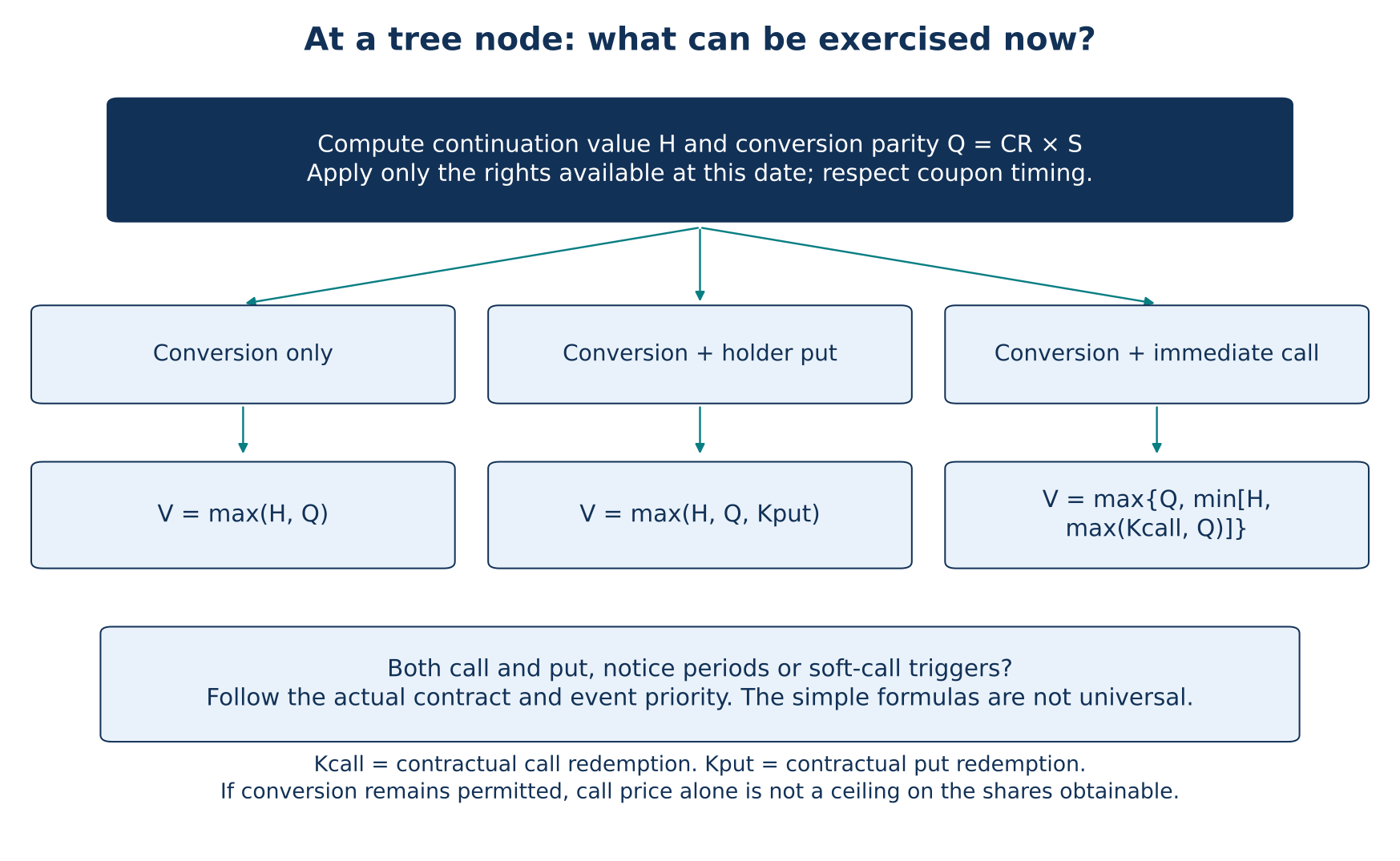
Apply exercise rights only on eligible dates
Let Q = CR x S be conversion value, H be continuation value, K_call be the call redemption amount and K_put be the put amount. For an idealized immediate call with conversion still permitted, the holder can choose max(K_call, Q) if called.
This expression assumes an exercisable issuer call, no notice-period uncertainty and no simultaneous put. If a put is also available, its treatment and event priority must follow the indenture. A convenient node rule when rights are compatible and put takes precedence is max(Q, K_put, min(H, max(K_call, Q))). It is not universal for conflicting terms.
| Scenario | Inputs | Decision / value |
|---|---|---|
| No exercise feature | H = 1,280; Q = 1,200 | Continue: 1,280 |
| Issuer can call | H = 1,280; Q = 1,200; call = 1,050 | Issuer forces choice; holder converts: 1,200 |
| Holder can put | H = 930; Q = 800; put = 1,000 | Put: 1,000 |
| Parity below call price | H = 1,100; Q = 900; call = 1,030 | Call redemption: 1,030 |
Why the call price is not always a price ceiling
In the call example, the investor receives shares worth INR 1,200 rather than cash of INR 1,050. The effective immediate-call cap is max(call amount, parity), not the call amount alone. Calling can remove remaining time value without eliminating existing conversion value.
Real calls often require advance notice. Stock prices can move during notice, and soft-call conditions may depend on a history of observations. These features require additional states or an appropriate approximation.
Excel-ready pricing walkthrough
Recreate case D without a specialized add-in
Use this cell map to build your own teaching worksheet; download the Excel companion from the learning resources section. Use full precision in formulas and format results to two decimals. All prices are per INR 1,000 face.
| Cell | Input / formula | Purpose |
|---|---|---|
| B2:B8 | 50; 1000; 20; 1.25; 0.80; 5%; 2 | S0; face; CR; u; d; rate; periods |
| B9 | =(1+B7-B6)/(B5-B6) | Risk-neutral p |
| D2 | =B2*B5 | Year 1 up stock |
| D3 | =B2*B6 | Year 1 down stock |
| F2 | =B2*B5^2 | Year 2 up/up stock |
| F3 | =B2*B5*B6 | Year 2 middle stock |
| F4 | =B2*B6^2 | Year 2 down/down stock |
| G2:G4 | =MAX($B$3,$B$4*F2) | Enter G2; fill down through G4 |
| E2 | =MAX($B$4*D2,($B$9*G2+(1-$B$9)*G3)/(1+$B$7)) | Year 1 up bond value |
| E3 | =MAX($B$4*D3,($B$9*G3+(1-$B$9)*G4)/(1+$B$7)) | Year 1 down bond value |
| B11 | =MAX(B4*B2,(B9*E2+(1-B9)*E3)/(1+B7)) | Convertible price: 1,064.50 |
| B12 | =B3/(1+B7)^B8 | Straight value: 907.03 |
| B13 | =B11-B12 | Conversion increment: 157.47 |
For case B, Excel straight value is =-PV(8%,5,40,1000), returning 840.2916. For case A, conversion premium ratio is =1100/(20*48)-1. For the Black-Scholes example, use NORM.S.DIST(d1,TRUE) and NORM.S.DIST(d2,TRUE).
Validation: require 0 <= p <= 1; check stock-tree recombination; compare against parity and straight value under the assumptions; increase steps until prices stabilize; test call/put dates and coupon handling separately.
Credit risk and advanced models
Why discounting everything at one risky yield is problematic
The problem
A convertible can settle through cash repayment or shares. Default may change both the promised debt payment and the stock price. Applying the issuer's risky debt yield to all equity-related payoffs can misprice the instrument; assuming the equity option is immune to issuer distress can also be misleading.
Tsiveriotis-Fernandes: a coupled decomposition
The TF approach separates total value into a cash-only part exposed to credit spread and an equity-related residual. In a simplified split-step explanation, let V = E + B_cash. Cash-only continuation is discounted at r + spread; the residual is discounted at r. At exercise, the split must be reset consistently: conversion leaves no cash-only claim; cash redemption is a cash claim. The two components interact through exercise decisions. [2]
This is a schematic explanation, not a complete production algorithm or a claim that the stock is default-free. The residual component's discounting convention must not be interpreted as eliminating equity losses on default.
Explicit default models
Ayache-Forsyth-Vetzal explicitly address default-related behaviour, including assumptions about equity jumps and recovery. A reduced-form implementation can model default intensity, survival, recovery cash flows and stock dynamics jointly. A structural approach links default and conversion to firm value and capital structure. Model choices can materially affect price and hedge ratios. [3, 4]
A credit spread is not automatically a default probability. The rough relationship spread = hazard rate x loss given default requires restrictive assumptions and omits liquidity and risk-premium effects. If default losses are explicitly included in expected cash flows, do not blindly add a full default spread again.
Price sensitivity and risk regimes
The dominant risk changes with the stock price
| Regime | Typical behaviour | Risks to emphasize |
|---|---|---|
| Bond-like / busted | Stock well below conversion price; conversion option has low value | Credit, recovery, refinancing, rates and liquidity |
| Balanced / hybrid | Stock near the conversion region; meaningful debt and option values | Equity delta and gamma, volatility, credit-equity dependence |
| Equity-like | Stock far above conversion price; value close to CR x stock | Equity market risk, dividends, calls and hedge execution |
A busted convertible need not be a safe bond. Weak equity often accompanies deteriorating credit. Conversely, an equity-like convertible still has contractual terms that may matter in a call, takeover or default.
| Change, other things equal | Typical effect on investor value |
|---|---|
| Stock price rises | Value generally rises; delta approaches CR in the equity-like region. |
| Stock volatility rises | Usually raises conversion-option value; callable/path-dependent structures can complicate the total effect. |
| Credit spread widens | Generally lowers value, especially the cash/debt component. |
| Risk-free rates rise | Straight debt value falls while equity-call value may rise; total effect is ambiguous. |
| Dividend yield rises | Usually lowers an unprotected conversion option; contractual dividend protection can offset this. |
| Holder put improves | Adds value and may shorten effective exposure. |
| Issuer call becomes more favorable | Reduces investor value relative to the otherwise identical issue. |
Time to maturity has competing effects: more time can benefit the equity option but increases exposure to credit and rates. Avoid unconditional claims about maturity, duration or volatility for complex structures.
Greeks and convertible arbitrage
Hedge the equity exposure; recognize what remains
Delta is shares per bond when V is currency per bond and S is currency per share. Delta divided by CR is a normalized equity participation measure. Gamma measures how delta changes with the stock price. Vega measures sensitivity to volatility; specify whether the reported number refers to a 1.00 change in volatility or a one-percentage-point change.
A practical hedge illustration
Suppose a desk holds 100 convertibles, each with CR = 20 and model delta = 12 shares per bond. A first-order equity hedge shorts 100 x 12 = 1,200 shares. A small stock move of INR 1 changes the bond position by approximately INR 1,200; the stock hedge changes by the opposite amount, before gamma and other effects.
The trade still carries credit-spread risk, volatility risk, funding and repo risk, stock-borrow costs, dividend payments on the short, liquidity risk, model risk and default gaps. Rebalancing is needed as delta changes. Convertible arbitrage is a relative-value strategy, not a guarantee of riskless profit. CFA Institute practitioner research examines this long-convertible/short-stock approach. [5]
First-order P&L map
Add interest-rate, credit-spread, time-decay and funding effects for a fuller attribution. These derivatives are local approximations; they can break down at default, exercise boundaries and market discontinuities.
Risk management questions
Can stock borrow be recalled? Is the call trigger close? How much of value is exposed to cash repayment? Does the model reproduce observed bond and equity markets? What happens if shares fall while spreads widen? Stress both markets together rather than treating them as independent.
Structures that must be distinguished
Similar names can hide very different payoffs
| Structure | Key distinction |
|---|---|
| Conventional convertible | Holder typically chooses whether to exchange debt for issuer shares; downside remains exposed to issuer credit. |
| Exchangeable bond | Converts into shares of a different company; issuer credit and underlying equity can differ. |
| Mandatory convertible | Conversion is compulsory under its terms, often with a variable share count; principal protection can be limited. |
| Contingent convertible (CoCo) | Loss absorption is triggered by specified capital or viability conditions; may convert or suffer a write-down. |
| Reverse convertible | Often embeds an investor-written equity put; the investor can receive impaired shares or equivalent cash. |
| Bond plus detachable warrant | Bond and warrant can trade separately; exercising a warrant usually requires an additional exercise payment. |
CoCos are bank-capital loss-absorption instruments, rather than ordinary holder-option convertibles. Trigger design and write-down versus equity conversion are central to their valuation. A familiar conversion ratio does not make them economically interchangeable with a conventional convertible. [6]
Income advantage and premium payback: a rough screen
In case A, 20 shares cost INR 960 versus INR 1,100 for the bond. If annual dividends are INR 0.50 per share, the share basket pays INR 10 while the bond pays INR 40. The simple annual income advantage is INR 30; the INR 140 premium divided by INR 30 gives 4.67 years.
This payback ignores time value, changing dividends, calls, default, price changes and unequal initial investment. It is an intuition aid, not a valuation model or a promised breakeven date. A conventional bond YTM likewise describes a specified redemption cash-flow path; it is not the expected return including conversion.
Original CFA-style practice
An integrated vignette with fully worked answers
Vignette: A three-year convertible has face INR 1,000, annual coupon 3%, CR = 25, stock price INR 36 and market price INR 1,050. Comparable straight debt yields 7% annually. The issuer may call at INR 1,020 on an eligible date; the holder retains conversion rights. Assume zero accrued interest.
| Question | Worked answer |
|---|---|
| 1. Contractual conversion price? | 1,000 / 25 = INR 40. |
| 2. Current conversion value? | 25 x 36 = INR 900. |
| 3. Market conversion price? | 1,050 / 25 = INR 42 per share. |
| 4. Conversion premium ratio? | 42 / 36 - 1 = 16.6667%. |
| 5. Straight value? | 30/1.07 + 30/1.07^2 + 1,030/1.07^3 = INR 895.03. |
| 6. Premium over straight value? | 1,050 / 895.03 - 1 = 17.3148% (using unrounded B). |
| 7. If stock is 48 when called? | Parity = 25 x 48 = INR 1,200; convert rather than accept INR 1,020. |
| 8. Is the current call price a ceiling? | No. An immediate call outcome respects the conversion alternative; in question 7 it is 1,200. |
Three conceptual checks
A. If spreads widen sharply while the share price falls, does the old straight value protect the purchase price? Answer: No; both components can weaken.
B. If the holder converts today, do future bond coupons continue? Answer: Ordinarily no; inspect accrued-interest terms.
C. Can four independently estimated vanilla option prices always be added and subtracted? Answer: No; exercise and termination rights interact.
These are original learning questions, not reproduced CFA examination questions. Round only final outputs; small differences from rounded intermediate values are normal.
Common errors and pricing workflow
A checklist for classroom and spreadsheet models
| Common error | Correction |
|---|---|
| Use face value as the bond floor | Revalue comparable debt using current credit and rate inputs. |
| Use P - CV as the premium ratio | Divide by CV for the conversion premium ratio. |
| Confuse premium denominators | (P - B)/B is premium over straight; (P - B)/P is decline to current straight value. |
| Value CR shares plus face at maturity | The holder generally chooses conversion or redemption, not both. |
| Convert as soon as S exceeds K | Compare parity with continuation value and income forgone. |
| Cap every callable bond at the call price | Allow conversion if the indenture permits it on a call. |
| Discount every branch at a risky YTM | Separate modelled credit and equity exposures consistently. |
| Add both default losses and full spread | Check the model for double-counting credit risk. |
| Historical probabilities / CoCos | Use risk-neutral pricing; model CoCo triggers separately. |
A disciplined pricing sequence
1. Extract the complete contract, calendars, settlement method and exercise priority.
2. Build the rate curve, issuer credit inputs, stock price, dividends, borrow assumptions and volatility surface.
3. Calculate parity, straight value and conversion-premium measures.
4. Select a benchmark, lattice or explicit-default model suited to the terms.
5. Apply coupons, calls, puts and conversion at the correct event times.
6. Check limiting cases, step convergence, model calibration and hedge ratios.
7. Compare price with market quotes and run joint equity-credit stress scenarios.
Interactive pricing and payoff explorer
Change the stock price, volatility, credit spread, coupon and exercise features. Compare the model value, straight-value benchmark, conversion parity and scenario outcomes. The standalone explorer includes a component chart and model assumptions.
Launch the explorer within this article
Three investigations
- Raise S from 24 to 48 to 72. Which component becomes more important?
- Hold S fixed and widen the credit spread. How does the straight-value benchmark change?
- Enable and disable the call and put separately. Explain the direction of each incremental value.
This is the supplied Google Sites explorer adapted for direct access on the academy website. Its original Google Sites editor is not a public visitor link. The TF-style model omits explicit default/recovery, call notice periods and soft-call history; event dates are approximated on the lattice. Dollar labels represent generic currency units. Greek estimates may show discretisation noise.
Excel and PDF learning resources
Excel Workbook
Work through the same main examples as this guide: parity ₹960, straight value ₹840.29, the two-period tree at ₹1,064.50, the exact default-free Black–Scholes benchmark at ₹1,091.31, and the component example at ₹1,065.
The workbook contains 10 learning sheets with worked pricing examples, annual cash-flow IRRs, practice problems and two pricing flowcharts. The cover maps the worksheets to this guide.
| Workbook area | What to use it for |
|---|---|
| Basic Illustration | Webpage conversion metrics and straight value |
| Full Cash Flow Example | Annual receipts, maturity decisions and correctly timed IRRs |
| Scenario Analysis | Maturity payoffs and returns, rather than forecasts of current prices |
| Advanced Valuation, Parts B–D | Matching binomial, exact Black–Scholes and component examples |
| Advanced Valuation, Part A | An additional, separately labelled approximation; no issuer call or holder put is priced |
The website’s TF-style explorer is a different pricing model. The Excel workbook does not reproduce that engine. The main cash-flow schedule supports 1–5 whole years. Independent concept and practice examples use their own stated inputs.
Linked vocabulary
- Conversion ratio
- The number of shares obtainable per bond.
- Conversion price
- Contractual reference price, commonly face divided by conversion ratio.
- Conversion value
- Current value of shares obtainable: stock price × conversion ratio. Also called parity.
- Market conversion price
- Bond market price divided by shares obtainable.
- Conversion premium
- Amount or percentage paid above conversion value; specify the denominator.
- Straight value
- Value of comparable debt after excluding conversion rights.
- Bond floor
- A moving debt-value benchmark, conditional on the contract and credit assumptions.
- Continuation value
- Value of holding the instrument instead of exercising at the current node.
- Issuer call
- Issuer’s contractual right to redeem on permitted terms.
- Holder put
- Investor’s right to demand contractual cash repayment.
- Soft call
- A call right that becomes available only after specified conditions are met.
- Credit spread
- Yield or discount-rate spread reflecting credit and other market compensation.
- Risk-neutral probability
- Pricing probability implied by the model’s no-arbitrage conditions.
- Delta
- Sensitivity to stock price, measured in shares per bond.
- Gamma
- Change in delta as the stock price changes.
- Vega
- Sensitivity to volatility; specify the bump unit.
- Recovery
- Value obtained after default, according to ranking and assumptions.
- Convertible arbitrage
- A relative-value strategy combining a convertible position with hedges.
- CoCo
- Contingent convertible capital instrument with trigger-based loss absorption.
Questions to test your understanding
Is a convertible always worth at least face value?
No. Face is a promised future amount. Current straight value can be below face and can deteriorate with credit risk.
Does in-the-money conversion mean convert immediately?
No. Holding can preserve time value and coupon income. Compare continuation with parity and contractual alternatives.
Why subtract the issuer call?
The issuer can terminate part of the investor’s future optionality on eligible terms. This reduces value relative to the otherwise identical non-callable issue.
Can stock price and credit risk be analysed independently?
They interact. Falling equity and wider credit spreads can weaken both equity optionality and cash repayment value.
Why does the TF cash component differ from straight bond value?
It is the cash-only portion of the convertible under optimal exercise, not the value of holding an otherwise separate straight bond.
Are the conversion premium and premium over straight value the same?
No. One uses conversion value as the denominator; the other uses straight value.
References and further study
- CFA Institute: 2026 Level II, Valuation and Analysis of Bonds with Embedded Options
- Tsiveriotis & Fernandes (1998): Valuing Convertible Bonds with Credit Risk
- Ayache, Forsyth & Vetzal (2003): The Valuation of Convertible Bonds With Credit Risk
- Ingersoll (1977): A Contingent-Claims Valuation of Convertible Securities
- Financial Analysts Journal: The Rise and Demise of the Convertible Arbitrage Strategy
- BIS: CoCos, a primer
- QuantLib: official convertible bond source example
Further reading: De Spiegeleer & Schoutens, The Handbook of Convertible Bonds; Calamos, Convertible Securities; Hull, Options, Futures, and Other Derivatives; Sundaresan, Fixed Income Markets and Their Derivatives; Fabozzi (editor), The Handbook of Fixed Income Securities. Coverage varies by edition. AnalystPrep and AnalystNotes can supplement the official exam-year curriculum.
Original teaching examples; no live market quotations. CFA-aligned learning material, independently written and not endorsed by CFA Institute. This guide distinguishes textbook benchmarks from simplified and advanced models.
Continue learning Fixed Income
Explore the other guides, worked examples and tools in the topic collection.
View all Fixed Income topics →